How to build the internal business case for AI visibility
You are convinced that AI assistants like ChatGPT matter for your brand. Your CEO, your IT lead and your data protection officer are not convinced yet. A business case is nothing more than the internal argument for spending money on something. This guide is for the person who has to make that argument. The short version: measure first, answer each decision-maker's real concern, and ask for a two-week trial instead of a yearly contract.
Get your own number before you pitch anything
First, the term itself. AI visibility means: when someone asks ChatGPT, Claude or Perplexity a question in your product category, does your brand show up in the answer? Before you talk to anyone internally, find out where you stand on exactly that. Skip the borrowed industry statistics; what gets attention in a meeting is what the assistants say about your own brand, today, verbatim. A free AI visibility check gives you that first snapshot without budget, procurement or a login.
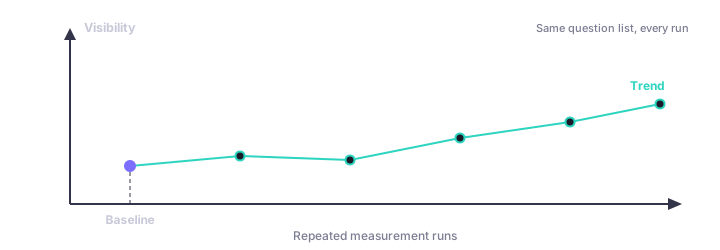
If the snapshot raises questions, turn it into a proper baseline. A baseline is simply a first measurement that all later measurements get compared against. In practice it looks like this: you write down a fixed list of questions your buyers actually ask (often called a question corpus), you run those questions through several assistants such as ChatGPT, Claude, Perplexity and Gemini, and you repeat the run every few weeks. The list stays frozen between runs, otherwise the numbers stop being comparable. Assistants also phrase their answers a little differently every time, which is exactly why a single screenshot proves nothing and repeated runs do.
The output is one sentence, and it carries the whole pitch: "We appear in X percent of the answers to our buying questions. Competitor Y is named about twice as often." Try getting that dismissed in a budget meeting. Budget owners postpone vague worries about AI all the time; they rarely postpone a measured gap with a competitor's name attached. The mechanics behind this kind of measurement, asking assistants the same questions on a schedule and logging what comes back, are covered in What is prompt monitoring?
Three people can kill this. Talk to each one differently.
An AI visibility project needs a yes from three offices: whoever owns the budget, IT, and data protection. These are your stakeholders, the people whose sign-off you need. Any one of them can stall the project for months, and to be fair, each of their objections is legitimate. The most common mistake is giving all three the same pitch. Give three different pitches, once each.

Stakeholder | Their real question | What convinces them |
|---|---|---|
Leadership / budget | "What do we get for the money?" | Two concrete value streams. First, support time saved: a visitor who finds a reviewed answer on your site does not email the same question to your team. Second, measurable movement in AI visibility, shown as trend lines from your own baseline rather than someone's projection. |
IT | "How much of my roadmap does this eat?" | No replatforming, meaning nothing in your core systems gets rebuilt or swapped out. The integration reads content that already exists: website, FAQ pages, help texts. Plus a written scope, before the pilot starts, of what IT provides and roughly how many hours it costs. |
Data protection | "What happens to personal data?" | A data processing agreement (the standard GDPR contract with any vendor that handles personal data), hosting in the EU, pseudonymization before any AI call (personal data gets swapped for neutral placeholders first), and a contractual commitment that your data is not used to train models. All of it in writing, not in a sales call. |
For the budget pitch, resist the urge to invent a return on investment, the classic slide that promises every euro spent will come back multiplied. You cannot back it up yet, and someone will remember the promise in a year. Anchor the pitch in the baseline gap and in a cost you already know: the hours your team spends answering the same questions over and over. For data protection, come prepared rather than defensive. A tool built for the EU market has these requirements in its architecture, not bolted on as paperwork afterwards. Klariton documents its own setup in the Compliance Center, which doubles as a checklist of questions to ask any vendor.
Let a two-week pilot do the convincing
A pilot is a small trial run with a fixed end date. Do not ask for an annual contract in the first meeting; ask for two weeks. That shifts the discussion from "do we believe this?" to "what did we find?", and it hands every stakeholder something concrete to react to instead of a slide.
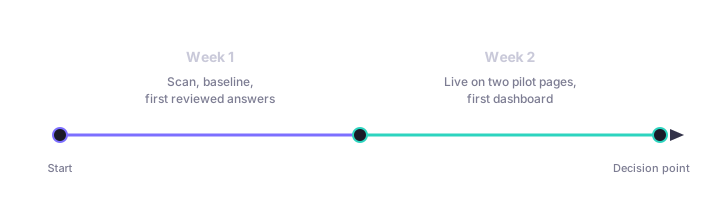
Agree with the budget owner, before the pilot starts, on what "worth continuing" means. A reasonable bar: the baseline is credible, the review workflow fits how your team already works, and the gap list contains work someone would genuinely do. If the pilot fails a bar you set yourself, you found that out for the price of two weeks. That is cheap.
Pick numbers you can still defend in six months
The fastest way to lose the internal case is to win it with a metric that falls apart later. Nobody can promise you "rank one in ChatGPT". There is no stable rank one to begin with: the same question gets slightly different answers depending on the run, the phrasing and the model version. A vendor who promises a fixed position is telling you something about the vendor, not about your visibility.
What holds up is duller: indicators measured the same way over time. Presence, meaning how often you appear in the answers to your fixed question list. Citation share, meaning how often assistants name your pages as a source compared to competitors' pages. And the number of content gaps closed since the last run. Report trends across repeated runs, never single readings, and say so upfront. Honest metrics cost you a little shine in the first meeting and buy you the credibility that keeps the budget alive in month six. Klariton's LLM Discovery is built around exactly these repeated-run indicators.
One caveat. If your web presence is thin overall, measurement will mostly confirm that, and the right first investment is content, not tooling. We wrote about when measuring pays off and when it is too early in Is AI visibility worth it for smaller brands?
Frequently asked questions
Ask your question about Klariton.
Grounded in Klariton’s own knowledge, cited rather than invented.
Klariton is an Answer Engine Optimization platform. It adds to your existing shop or website without replacing anything or migrating data. Your own knowledge becomes verified, source-based answers (BIQs) that AI assistants and your visitors use directly.
Product copy, FAQs, spec sheets, your CMS or shop catalog. Klariton processes your material read-only and turns it into cited answers. Your data is never used for model training.
All AI calls run EU-hosted. Personal data is pseudonymized before every call. Klariton reads your sources read-only and stores no plain-text customer data.
Every answer is source-backed and passes a review gate. Nothing is published unchecked. Safe Guard continuously watches published answers against your material and flags outdated or weak claims.
No. Klariton integrates with your existing site, with no platform switch or migration. One embed is enough, and your CMS stays the source of truth.
Plans scale with touchpoints and answer volume. The AI visibility check is free and needs no sign-up. For everything else, just talk to us.
How visible is your brand to AI?
The free AI visibility check shows you in under a minute how AI assistants see your shop today.