What buyers actually compare before choosing an AI answer platform
An AI answer platform is software that answers customer questions with AI: on your own website, and ideally in assistants like ChatGPT too. Most comparison articles about these tools are feature grids written by one of the vendors. This is the other kind. We walk through the three options buyers actually shortlist, what each one is genuinely good at, and the four criteria the decision really turns on. Price comes after those four, on purpose.
The three options on most shortlists
The problem usually shows up in one of two places. Either your website cannot answer customer questions on its own, or assistants like ChatGPT say things about your brand that you never wrote. Once a team decides to act on either one, the same three families of tools end up on the shortlist almost every time. Each is a rational choice for someone. A fair comparison says for whom.
Option | Genuinely good at | Trade-offs to know |
|---|---|---|
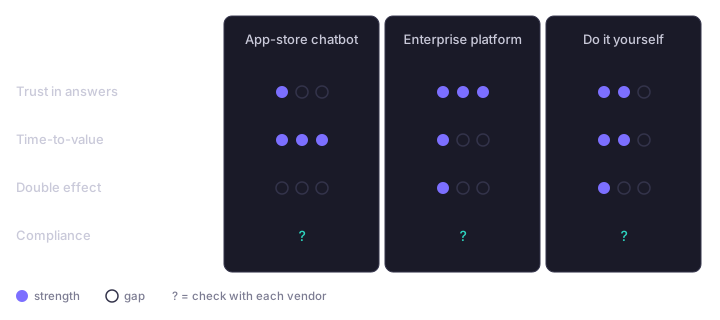
App-store chatbots (Tidio and similar) | Cheap and installed in minutes. You get a chat window on your site the same day. A reasonable first step if the goal is deflection: routine questions get answered automatically, so fewer tickets reach your support inbox. | Most cannot show which of your pages an answer came from, and there is usually no step where a human checks an answer before customers see it. They also do nothing about how your brand shows up inside AI assistants, and they do not measure it. |
Enterprise search and answer platforms (Algolia, Coveo) | Powerful and proven at large scale. Companies with a very large body of content get deep relevance tuning (fine-grained control over which result ranks where) and integrations with almost anything. | Buying one means starting a project. You need engineers for setup and maintenance, implementation takes months rather than days, and pricing assumes an enterprise budget. |
Do it yourself (maintained FAQ page plus manual ChatGPT use) | Free, apart from your time. A well-kept FAQ page has real value on its own, and it doubles as source material AI assistants can read. | You are flying blind. You do not learn which questions go unanswered, whether assistants cite you, or whether last month's work moved anything. |
Note what is missing from the table: a verdict. A three-person shop with simple support questions is well served by the first row. A corporation with a search team already in place belongs in the second. The problems start when a mid-size team buys row one expecting row two, or tries row three and expects it to keep improving with nobody measuring anything.
The four criteria real buying processes turn on
Strip away the feature grids, and the decisions we see in actual buying processes come down to four questions. They are worth asking about any option, including us.
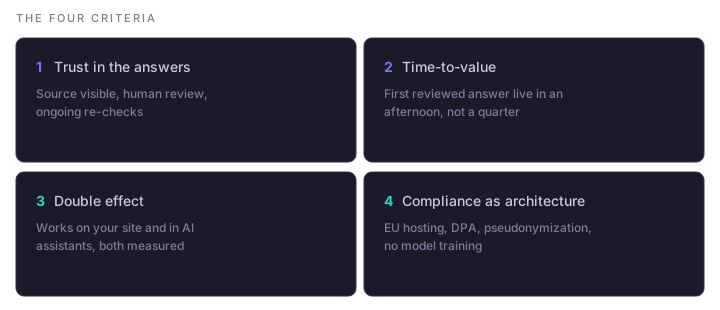
How that ongoing re-checking works in practice is a topic of its own; we cover it in What is prompt monitoring?. And the compliance questions from criterion 4 belong in front of every vendor on your list. Klariton answers them publicly in its Compliance Center, which doubles as a checklist for asking everyone else.
Price comes fifth, on purpose
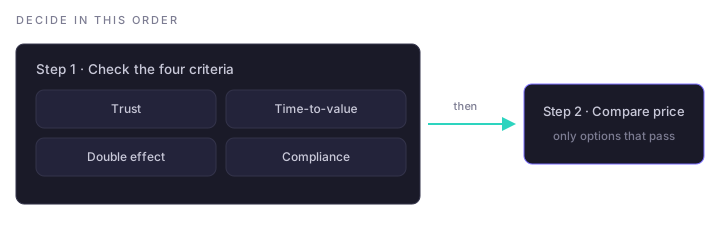
Price matters. It comes last because a price tells you nothing until you know what you are getting for it. A cheap tool that fails criterion 1 costs you trust with every wrong answer. An enterprise platform that fails criterion 2 eats a quarter of engineering time before you see anything. So settle the four criteria first, then compare what each option charges for what it actually delivers. Done in that order, the price discussion tends to be short and unemotional.
Where Klariton honestly fits
Klariton is a fourth option. The fairest way to describe it is against the four criteria, not with adjectives. Every published answer shows the page it came from. Nothing goes live until someone on your team has approved it. The effect is measured on both ends, on your site and in AI assistants, through LLM Discovery. And EU hosting, the data processing agreement and the pseudonymization step are part of the architecture, not options on a price list.
That does not make the other options wrong. Need basic chat coverage this week at minimal cost? An app-store chatbot is a fine answer. Running a large body of content with a dedicated team? The enterprise platforms are built for you, and evaluating them properly will take more than this article. Klariton is built for the team in between: too small for a platform project, too invested in its brand to leave AI answers unmanaged. Whether that is you takes minutes to find out. Run the free AI visibility check and read what assistants currently say about your brand. If the result stings, we covered how to win the internal budget discussion in How to build the internal business case for AI visibility.
Frequently asked questions
Ask your question about Klariton.
Grounded in Klariton’s own knowledge, cited rather than invented.
Klariton is an Answer Engine Optimization platform. It adds to your existing shop or website without replacing anything or migrating data. Your own knowledge becomes verified, source-based answers (BIQs) that AI assistants and your visitors use directly.
Product copy, FAQs, spec sheets, your CMS or shop catalog. Klariton processes your material read-only and turns it into cited answers. Your data is never used for model training.
All AI calls run EU-hosted. Personal data is pseudonymized before every call. Klariton reads your sources read-only and stores no plain-text customer data.
Every answer is source-backed and passes a review gate. Nothing is published unchecked. Safe Guard continuously watches published answers against your material and flags outdated or weak claims.
No. Klariton integrates with your existing site, with no platform switch or migration. One embed is enough, and your CMS stays the source of truth.
Plans scale with touchpoints and answer volume. The AI visibility check is free and needs no sign-up. For everything else, just talk to us.
How visible is your brand to AI?
The free AI visibility check shows you in under a minute how AI assistants see your shop today.