AI has to trust you before it recommends you.
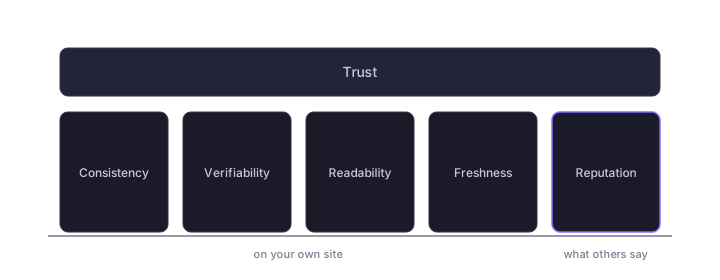
When an AI assistant names a brand, it vouches for that brand with its own credibility. So before your company appears in an answer, the assistant runs the machine version of a background check. Four things decide the outcome: consistency, verifiability, readability and freshness. All four are yours to control.
A recommendation is an act of trust
There is a reason AI assistants hedge, attribute and omit: every recommendation they make is a promise to their user. If the recommended shop turns out to have wrong prices, a dead address or contradictory claims, the user blames the assistant. The platforms know this. Visa is currently building the payment plumbing for purchases made by AI, and its Earning Trust report frames the whole field around exactly this question: an AI agent buying on a user's behalf only works if trust holds along the entire chain, down to the merchant at the end of it.
That makes trust the gate to AI visibility. Being findable gets you considered. Being verifiable gets you recommended. And unlike human trust, machine trust is built from signals a crawler can check in seconds. A crawler, in case the word is new, is simply the program an AI system sends out to read websites. Four groups of signals do most of the work:
Consistency: do all sources tell the same story?
AI engines, meaning the systems that build the answers inside ChatGPT, Perplexity and the rest, rarely rely on a single source. Before naming a brand, they cross-reference: does the website say the same thing as the business directory, the review platform, the social profile? Every mismatch is a warning sign, and mismatches are depressingly easy to accumulate. A company renamed two years ago but still listed under its old name in three directories. An address that differs between the legal notice and the map entry. Opening hours that disagree with the profile. A service page promising something the pricing page contradicts.
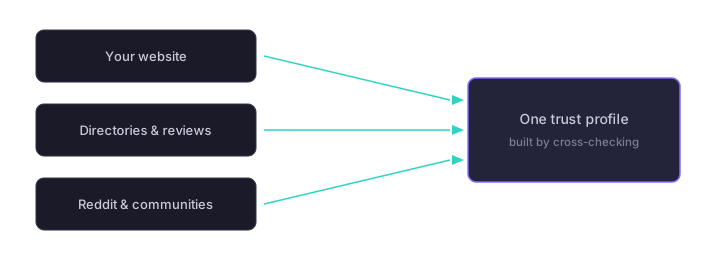
For a human, these are trivia. For an engine, they are unresolved contradictions about basic facts, and a source that contradicts itself on basic facts does not get to be the source for harder claims. It works like a job application where the CV and the references disagree: nobody reads the rest more charitably after that.
The audit itself is mundane and worth more than it looks: list every place your company data exists, compare it against your website, and make them agree. Name, address, offering, prices, hours, in that order of importance.
Verifiability: can a machine establish that you are real?
The second check is existential: is this an actual company? Engines have learned to look for the unglamorous markers of realness: a complete legal notice, a physical address that resolves, named people instead of anonymous teams, a company register entry that matches, contact channels that do not dead-end. These pages were long treated as legal chores. In AI answers they act as identity documents.
Verifiability extends to what you claim about yourself. Statements with sources, checkable facts and named references read as trustworthy. Unsupported superlatives do the opposite, and assistants have a distinctive way of handling those: they quote them with distance instead of adopting them, a mechanism worth understanding in detail in how AI uses your own content against you.
Technical readability: does the crawler even get in?
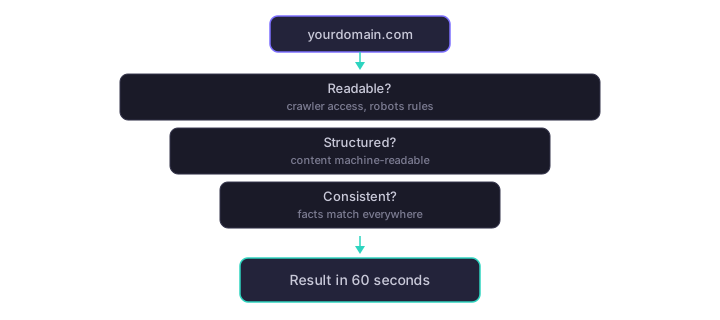
The most underrated trust failure is the invisible one. A website can be beautiful for humans and unreadable for machines: content that only appears after scripts run in the browser, which many crawlers never execute; key facts locked inside images; AI crawlers shut out by robots rules (the small file on your server that tells crawlers what they may read) that nobody has reviewed since they were set; essential information reachable only through clicks and popups. The engine does not see a trustworthy site with access problems. It sees a thin page with nothing to verify, and it fills the gap with third-party sources, or with a competitor it could read.
This is the one signal you cannot judge by looking at your own site in a browser, because you are not the crawler. Whether AI can actually read and classify your website is exactly what the free check shows you, in about 60 seconds and without any setup.
Freshness: is anyone still home?
Trust decays. A price list from two seasons ago, a team page with departed employees, a blog that stops abruptly, a discontinued offer still advertised: each of these is a small signal that the information here is not maintained. Engines weigh that, for good reason: recommending from stale data produces exactly the wrong answers that cost user trust. An assistant that quotes your old price to a customer creates a broken promise you never made.
Freshness does not mean constant publishing. It means the pages that exist are current: visible dates where they help, no orphaned pages contradicting live ones, prices and offerings that match reality. A small, current site outperforms a large, decaying one.
External reputation: what third parties say about you
Trust signals do not end at your own domain, because assistants weigh what others say about you at least as heavily as what you say yourself. The sources they lean on are measurable. In a Semrush analysis spanning three months, Reddit was the most cited domain in AI answers across the major engines; cited simply means the answer linked to it as a source. And 5W Research found that Wikipedia and Reddit together drive over 25% of ChatGPT citations in the US. An honest caveat belongs next to those numbers: citation patterns are volatile. Shares swing considerably between engines and across months, which is one more argument for measuring trends instead of trusting a single snapshot.
The practical consequence is uncomfortable for anyone hoping to shortcut it: what communities say about your brand is part of your trust profile. Genuine community presence pays off: real answers to real questions in relevant subreddits, the topic forums on Reddit, honestly and under your own name, useful in the places your customers already ask. Astroturfing, the practice of faking that enthusiasm with planted posts and bought recommendations, backfires twice over: the fakes tend to get called out publicly, and the callout thread then becomes the third-party source the engines read. And whatever Reddit currently says about your brand belongs in your monitoring, right next to your own claims.
The self-check, compressed
Signal | Question to ask | Quick test |
|---|---|---|
Consistency | Do all public sources agree on my basic facts? | Compare name, address, offering and prices across website, directories and profiles. |
Verifiability | Can a machine establish that we are real? | Legal notice complete, address real, people named, claims sourced. |
Readability | Can AI crawlers reach and read the content? | Run the 60-second check; review robots rules for AI crawlers. |
Freshness | Is everything still true today? | Hunt for orphaned pages, old prices, discontinued offers, outdated team info. |
Reputation | What do third parties, Reddit above all, say about my brand? | Search your brand in relevant subreddits and on review platforms; keep watching the mentions over time. |
None of this is a one-time project, because the other side is scaling up. Gartner predicts that by 2028, 60% of brands will use agentic AI, meaning AI that acts on a user's behalf, for one-to-one interactions. So the one deciding whether to mention you will, more and more often, be a machine reading these exact signals. Whether the work is paying off is measurable from the outside: ask the engines your customers' questions on a fixed schedule and track whether your brand appears, and how it is described. That routine has a name, prompt monitoring. And once assistants do talk about you, keeping what they say accurate is its own craft, covered in how to prevent AI hallucinations.
Frequently asked questions
Ask your question about Klariton.
Grounded in Klariton’s own knowledge, cited rather than invented.
Klariton is an Answer Engine Optimization platform. It adds to your existing shop or website without replacing anything or migrating data. Your own knowledge becomes verified, source-based answers (BIQs) that AI assistants and your visitors use directly.
Product copy, FAQs, spec sheets, your CMS or shop catalog. Klariton processes your material read-only and turns it into cited answers. Your data is never used for model training.
All AI calls run EU-hosted. Personal data is pseudonymized before every call. Klariton reads your sources read-only and stores no plain-text customer data.
Every answer is source-backed and passes a review gate. Nothing is published unchecked. Safe Guard continuously watches published answers against your material and flags outdated or weak claims.
No. Klariton integrates with your existing site, with no platform switch or migration. One embed is enough, and your CMS stays the source of truth.
Plans scale with touchpoints and answer volume. The AI visibility check is free and needs no sign-up. For everything else, just talk to us.
How visible is your brand to AI?
The free AI visibility check shows you in under a minute how AI assistants see your shop today.