GDPR, DPAs and audit logs: using AI tools without legal headaches
AI tools do not get a compliance discount. The GDPR rules that apply to your CRM apply to your AI stack too. Here is what to check before you connect one to customer-facing workflows, and how Klariton approaches each point.
Note: this article is general information, not legal advice. For decisions about your specific setup, talk to a qualified data protection professional.
Most teams adopting AI tools are not reckless; they are busy. A tool solves a real problem, someone connects it, and the compliance questions arrive later, usually from a customer's procurement department. The good news: the questions are predictable. The GDPR does not have a special AI chapter. It asks the same things it always asks, just with new failure modes.
What does the GDPR actually require when you use AI tools?
Whenever an AI tool touches personal data, the usual framework applies. You remain the controller: you decide why and how data is processed, and you stay responsible for it. The AI vendor is typically a processor acting on your instructions. From that follows a familiar checklist: a lawful basis for the processing, transparency toward the people whose data it is, purpose limitation, and security appropriate to the risk.
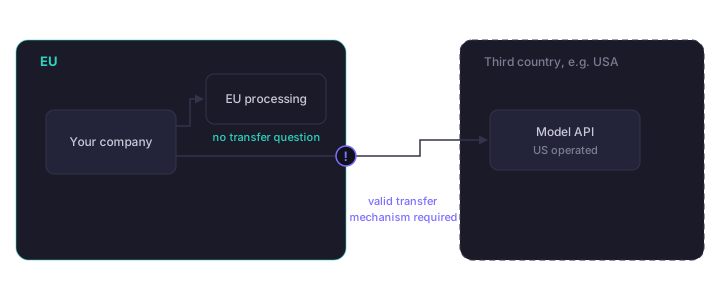
The AI-specific twist is mostly about where data flows. A support ticket that used to stay in your helpdesk may now be sent to a model API, possibly operated by a different company, possibly in a different jurisdiction. Every one of those hops needs an answer.
And people keep their rights when your tooling changes. Access, rectification, erasure, objection: if a customer asks what you hold about them or wants it deleted, you must be able to answer across your AI tools too. That gets hard when personal data has been scattered into prompts, logs and vendor-side storage nobody catalogued. The pragmatic rule is simple: the less personal data enters the AI pipeline, the smaller the surface you have to search when a request arrives.
What is a DPA and when do you need one?
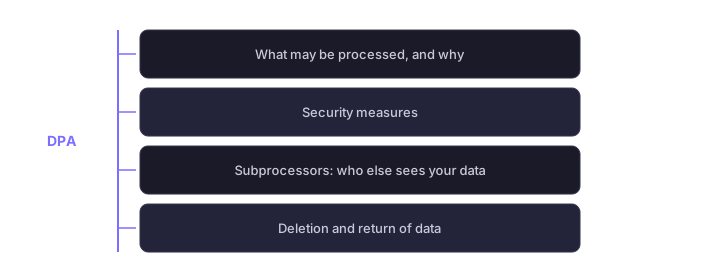
A data processing agreement (DPA, in German: AVV) is the contract the GDPR requires between a controller and a processor. It pins down what the vendor may do with the data, how it is secured, which subprocessors are involved, and what happens on deletion. If an AI tool processes personal data on your behalf, and almost every tool that sees emails, chats or customer accounts does, a DPA is not optional paperwork; it is the legal basis for the relationship.
Two practical checks: first, does the vendor offer a DPA at all without an enterprise sales call? Second, read the subprocessor list. That is where you learn which model providers and hosting companies actually see your data.
Are transfers outside the EU a problem?
They are a manageable problem, but only if you know they are happening. Many popular model APIs are operated from third countries, most prominently the United States. Transfers there need a valid mechanism, such as an adequacy decision or standard contractual clauses, plus an honest look at whether the safeguards hold up in practice. The alternative that avoids the question entirely: EU hosting and EU processing, so the data never crosses the border in the first place.
Why do audit logs matter for AI-generated content?
The GDPR's accountability principle means you must be able to show compliance, not just assert it. For AI-assisted workflows that translates into a concrete artifact: an audit log. Who approved this AI-drafted answer? When? What did the previous version say? If a regulator, a customer or your own lawyer asks how a piece of published content came to be, “the model wrote it” is not an answer. “Drafted on the 3rd, reviewed and approved by M. on the 5th, revised after a product data change on the 12th” is.
Question for your AI vendor | Why it matters |
|---|---|
Is a DPA available, with a subprocessor list? | Without it there is no compliant controller-processor relationship, and no visibility into who really sees your data. |
Where is data hosted and processed? | EU-only processing avoids the whole third-country transfer analysis. |
Does personal data reach the model? | Pseudonymisation or filtering before AI calls shrinks your risk surface dramatically. |
Is there an audit trail for approvals? | Accountability requires records of who approved what, and when. |
What is retained, and for how long? | Data minimisation and deletion duties extend into vendor-side logs and training pipelines. |
What does data minimisation look like in practice?
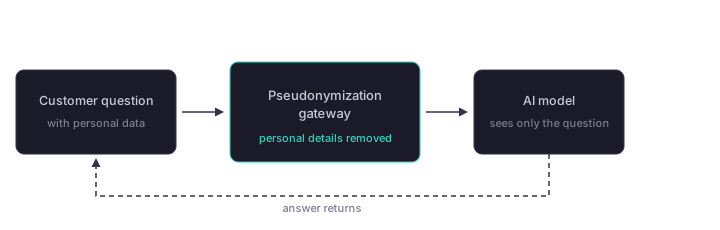
Data minimisation is the least glamorous and most effective control: only process the personal data you actually need. For AI tooling that means asking, for each call, whether the model needs the customer's name, email or order history to do its job, or whether an anonymous or pseudonymous version works just as well. In most content and commerce workflows, it does. A model drafting a product answer needs the question, not the questioner.
How does Klariton handle all of this?
Klariton was built for EU commerce, so these requirements shaped the architecture rather than being bolted on:
EU hosting. The platform runs on EU infrastructure.
Pseudonymisation gateway. Every AI call passes through a pseudonymisation layer first. Real names do not leave the system toward the LLM.
Audit trail in the Compliance Center. Who approved which answer, and when, is recorded and reviewable.
Public content only in feeds. Machine-readable outputs like feeds and llms.txt carry only content that is already public, never customer data.
DPA available. A data processing agreement is part of the standard setup, not an enterprise extra.
None of this replaces your own compliance work; it just means the tool is not the weakest link in it. One more time, because it matters: this article is general information, not legal advice.
Ask your question about Klariton.
Grounded in Klariton’s own knowledge, cited rather than invented.
Klariton is an Answer Engine Optimization platform. It adds to your existing shop or website without replacing anything or migrating data. Your own knowledge becomes verified, source-based answers (BIQs) that AI assistants and your visitors use directly.
Product copy, FAQs, spec sheets, your CMS or shop catalog. Klariton processes your material read-only and turns it into cited answers. Your data is never used for model training.
All AI calls run EU-hosted. Personal data is pseudonymized before every call. Klariton reads your sources read-only and stores no plain-text customer data.
Every answer is source-backed and passes a review gate. Nothing is published unchecked. Safe Guard continuously watches published answers against your material and flags outdated or weak claims.
No. Klariton integrates with your existing site, with no platform switch or migration. One embed is enough, and your CMS stays the source of truth.
Plans scale with touchpoints and answer volume. The AI visibility check is free and needs no sign-up. For everything else, just talk to us.
How visible is your brand to AI?
The free AI visibility check shows you in under a minute how AI assistants see your shop today.