GEO vs. SEO: how visibility works when the answer replaces the ranking.
Search taught marketers to think in rankings: ten blue links, a position to climb, a click to win. Generative engines do not work that way. Here is what carries over, what breaks, and how you measure the difference.
What is GEO, and why does it exist?
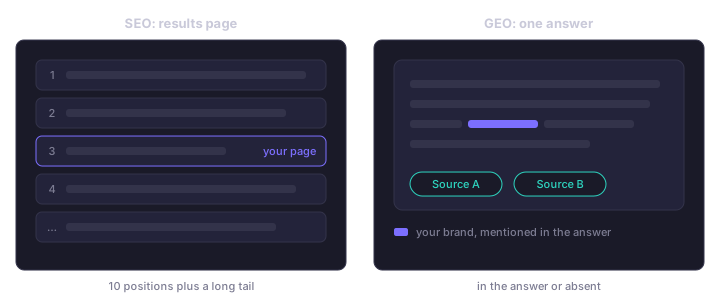
GEO stands for generative engine optimization: the practice of making your brand and your content more likely to appear in the answers that AI assistants generate. Where SEO targets a results page, GEO targets the answer itself, the paragraph that ChatGPT, Claude, Perplexity or Gemini composes when someone asks a question in your category.
The discipline exists because buyer behavior is shifting. More and more product research starts as a conversation with an assistant: which tool fits my case, what should I look out for, is this brand any good. Nobody can put a precise number on that shift, and you should be skeptical of anyone who claims they can. But the direction is clear enough that brands have started asking the obvious question: what do these assistants actually say about us?
What does GEO inherit from SEO?
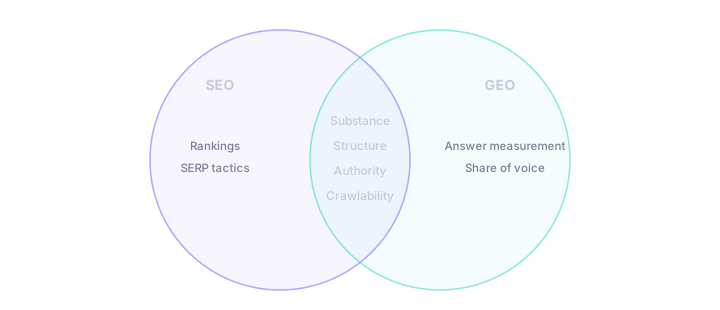
The good news first: GEO is not a reset to zero. Generative engines learn from and cite the same web that search engines index. Much of what made you findable keeps paying in:
Substance. Content that actually answers questions, with specifics instead of slogans, is what assistants can quote and paraphrase.
Structure. Clear headings, clean markup and pages that get to the point help machines extract meaning, whether the machine ranks or generates.
Authority. Being referenced by sources an assistant trusts still matters, even if the weighting differs between engines.
Crawlability. A bot that cannot read your page cannot cite it. That was true for search crawlers, and it is true for AI crawlers.
If you have done honest SEO work, you are not starting over. You are starting from a base.
What changes when the answer replaces the ranking?
The differences are structural, not cosmetic.
There is no position four. A results page has ten slots and a long tail. An answer has a handful of sentences. Either you are in it or you do not exist for that question. Visibility stops being a gradient and becomes a threshold you either clear or miss.
The answer is synthesized. The assistant blends several sources into one text and may name brands without linking to them. You can be present in an answer and see nothing of it in your referral traffic.
There is no neutral results page to check. Answers vary with phrasing, context, chat history and model version. Looking once proves nothing. Only repeated, structured measurement does.
The visit may never happen. Users increasingly act on the answer without clicking, and AI agents read pages on behalf of users. Your server sees a bot read where your analytics used to see a session.
SEO vs. GEO at a glance
SEO | GEO | |
|---|---|---|
Surface | Search results page | Generated answer |
Unit of success | Ranking position for a keyword | Presence and citation in the answer |
Competition | Ten visible slots plus a long tail | Mentioned or absent |
Verification | Check the SERP, use search console data | Ask the engines yourself, repeatedly |
Traffic signal | Sessions and clicks | Answers, citations and agent reads |
Feedback rhythm | Crawl and index cycles | Model and retrieval updates |
How do you measure GEO success?
This is where GEO differs most sharply from SEO in daily practice. Search gives you consoles, rank trackers and click data. Generative engines give you nothing by default. There is no dashboard from the model providers telling you how often your brand appeared in last month's answers. If you want the number, you have to generate it: ask the assistants the questions your buyers ask, at scale, on a schedule, and analyze what comes back.
That is the approach behind Klariton. A question corpus is generated from your own customer questions, your personas and your brand core, and you review and explicitly freeze it before the first run, so results stay comparable over time. The corpus then runs against ChatGPT, Claude, Perplexity and Gemini. Out of the answers come the metrics that make GEO manageable: share of voice as your share of provider citations, recommendation risk showing which competitors are named in your place, and content opportunities with a score that tells you which gap to close first. Bot-read tracking adds the agentic side: which AI bots actually read your pages. And because measuring means real model calls, you see a cost estimate before each run and a budget cap keeps every run bounded.
Do you have to choose between SEO and GEO?
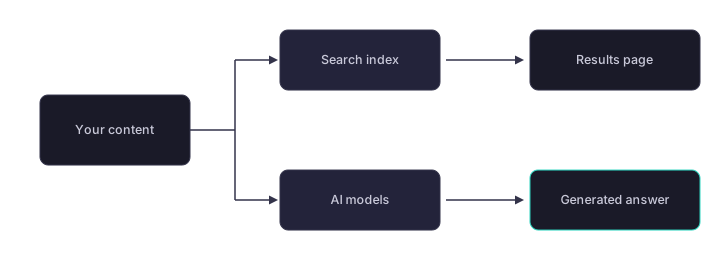
No, and framing it as a war is mostly content marketing. The two share a supply chain: the content you publish feeds both the search index and the models. The practical stance is additive. Keep the SEO fundamentals that still earn their keep. Add measurement on the answer layer so you know where you stand. Then let the findings, not the hype, decide how much effort GEO deserves in your case.
A brand that is invisible in AI answers for its core buying questions has a GEO problem worth working on. A brand that is already well represented may just need to keep watching. Without measurement, you cannot tell which one you are.
Frequently asked questions
Ask your question about Klariton.
Grounded in Klariton’s own knowledge, cited rather than invented.
Klariton is an Answer Engine Optimization platform. It adds to your existing shop or website without replacing anything or migrating data. Your own knowledge becomes verified, source-based answers (BIQs) that AI assistants and your visitors use directly.
Product copy, FAQs, spec sheets, your CMS or shop catalog. Klariton processes your material read-only and turns it into cited answers. Your data is never used for model training.
All AI calls run EU-hosted. Personal data is pseudonymized before every call. Klariton reads your sources read-only and stores no plain-text customer data.
Every answer is source-backed and passes a review gate. Nothing is published unchecked. Safe Guard continuously watches published answers against your material and flags outdated or weak claims.
No. Klariton integrates with your existing site, with no platform switch or migration. One embed is enough, and your CMS stays the source of truth.
Plans scale with touchpoints and answer volume. The AI visibility check is free and needs no sign-up. For everything else, just talk to us.
How visible is your brand to AI?
The free AI visibility check shows you in under a minute how AI assistants see your shop today.