How to interview your target audience with AI, and what it actually reveals.
Proper market research costs money most small teams do not have. There is a workable middle way: interview an AI that plays your customer. Same seven questions every time, follow-ups until the vague parts break. Here is the exact script, two findings from real projects, and the mistake that quietly ruins the results.
What a persona interview with AI actually is
First, the word. A persona is a written sketch of one typical customer: their job, their day, the thing they are trying to get done, the stuff that annoys them along the way. Most companies have a few of these sketches somewhere. Usually half-finished, in a slide deck nobody opens.
A persona interview with AI takes that sketch and makes it talk back. You describe the person to an AI model in as much detail as your material allows. Then you ask questions, one at a time, the way a market researcher would. The model answers in character, you follow up, you write things down. That is the whole method. No agency, no six-week study.
Be honest with yourself about what you get. The AI does not know your customers. It knows your description of them, plus general patterns from its training. So the interview will not reveal secret facts about your market. What it does, and does surprisingly well, is stress-test your own assumptions. It forces you to write them down, and then it shows you where they are vague, contradictory or missing. "Our customers value quality" feels solid until an interview makes you say which quality, measured how, compared to what.
Two rules decide whether this produces insight or fan fiction. Rule one: work from real material. Feed the interview with support emails, product reviews, notes from sales calls, real sentences from real customers. A persona built from pure imagination interviews back like a brochure. Rule two: never accept a vague answer. When the model says "they value efficiency", push back. Ask for the concrete bottleneck. Ask for the sentence this person would actually say in a meeting. The follow-up question is the entire craft here.
The seven questions, ready to copy
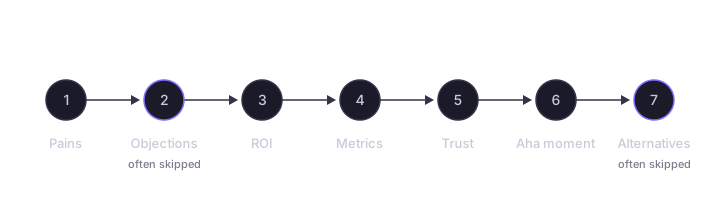
This is the script we run, seven questions per persona. It looks boring on purpose. The value is in the answers.
# | The question | What it surfaces |
|---|---|---|
1 | What concrete problems and bottlenecks does this person have today? | Their pains in their words, not your feature list. |
2 | What objections would their team raise against a solution like yours? | The internal pushback you must answer before anyone says it out loud. |
3 | How do they tell vendors apart, and what justifies the ROI, the return on the money spent? | Their comparison criteria and the business case you have to serve. |
4 | Which metrics, meaning the numbers they are judged by at work, do they use? | The numbers your content and your pitch must speak to. |
5 | Where do they get trust and validation? | The channels and kinds of proof that actually carry weight with them. |
6 | What would their aha moment be? | The one answer or demo moment that belongs right at the front. |
7 | Which alternatives do they compare, and what tips the decision? | The real shortlist, including the strongest competitor of all: doing nothing. |
A tip from running this often: questions 2 and 7 are the ones people skip, and they are the two that pay the rent. Objections and alternatives are where deals actually die.
Run all seven per persona and write the answers down like quotes. Where two personas answer the same way, you have found a message that works for everyone. Where their answers collide, you need that answer twice, in two versions, on two pages.
Two findings from real projects
Both examples are real and anonymized. No names, no numbers. The useful part is the shape of the finding, and that survives anonymization just fine.
The coffee case first. A retailer selling higher-grade beans online expected a price-driven customer. The interviews said otherwise: the purchase decision falls at advice quality. A shopper who gets a straight answer to "does this suit a fully automatic machine, and at which grind?" buys. A shopper who gets a tasting poem does not. So brewing guidance, machine compatibility and taste-profile comparisons moved out of the blog's back pages and into the buying path itself.
The software case travels further. B2B means selling to other companies, and SaaS is software sold by subscription, so the buyer is never one person. The enthusiastic insider is usually called the champion: the employee who loves your product and pitches it internally. The champion was never the problem, they were convinced on day one. The deal died in internal meetings the vendor never saw, because the champion had nothing to forward when the budget owner asked about long-term cost, IT asked what it connects to, and the privacy officer asked where the data goes. The fix was unglamorous: answer pages the champion could paste straight into an email thread.
Both findings land in the same place. Early, while the visitor is still deciding whether to take you seriously. That is exactly the phase where trust is decided, long before anyone talks price.
Why a US persona flops in Germany
Now the part most teams miss: a persona is not just a role. It is a role inside a market. Same job title, different country, different person for your purposes.
Take a purchasing manager in 2026. The US one is thinking about imports and tariffs while sizing up a supplier. The German one is more likely weighing energy costs, supply chain rules and data protection duties. Same role, same seven questions, structurally different answers. Why? Because their stakeholders differ, the colleagues who get a say in the purchase, and those colleagues want different reassurances in each country.
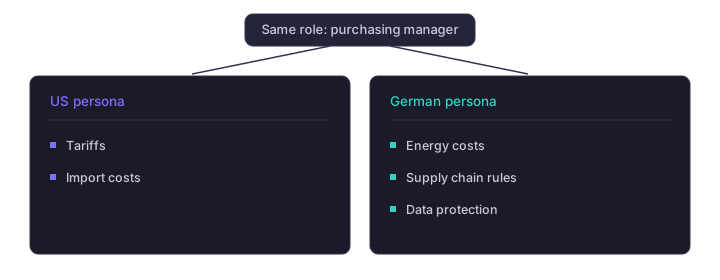
Copy a US persona unchanged into the German market, or the reverse, and your content starts answering the wrong worries. Fluently, confidently, wrong. And the visitors who notice are exactly the careful ones you wanted most.
The consequence is a habit, not a hack: run the interviews per market, and localize the answers per market instead of just translating them. A translated objection-handler still handles the other market's objection. Questions 2 and 5 shift the most across borders. If you must cut a corner somewhere, do not cut it there.
From transcript to answers your visitors can find
An interview that ends as a document nobody opens has changed nothing. The output you actually want is published answers: each important persona question, paired with a concrete answer and the source it rests on. One question, one answer, one source, a unit we call a BIQ. That is how the research becomes the thing your visitor actually meets.
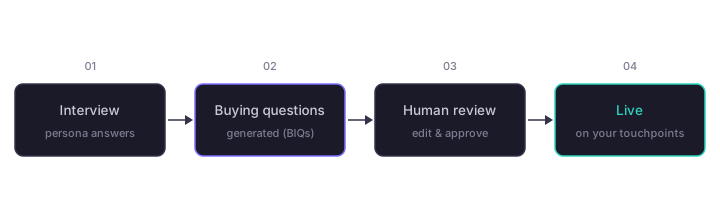
In Klariton, this method is built in rather than bolted on. The Touchpoint Wizard runs exactly these interviews per persona and turns them into source-backed answer suggestions, including the follow-up questions a real visitor would ask next. And because personas are market-specific, multilingual touchpoints answer per market: the German visitor gets the compliance answer, the US visitor gets the tariff answer, and neither gets a translation of the other's. On the website itself, the Chat Advisor is where those persona-specific answers meet a real person, at the exact moment the question is live.
Frequently asked questions
Ask your question about Klariton.
Grounded in Klariton’s own knowledge, cited rather than invented.
Klariton is an Answer Engine Optimization platform. It adds to your existing shop or website without replacing anything or migrating data. Your own knowledge becomes verified, source-based answers (BIQs) that AI assistants and your visitors use directly.
Product copy, FAQs, spec sheets, your CMS or shop catalog. Klariton processes your material read-only and turns it into cited answers. Your data is never used for model training.
All AI calls run EU-hosted. Personal data is pseudonymized before every call. Klariton reads your sources read-only and stores no plain-text customer data.
Every answer is source-backed and passes a review gate. Nothing is published unchecked. Safe Guard continuously watches published answers against your material and flags outdated or weak claims.
No. Klariton integrates with your existing site, with no platform switch or migration. One embed is enough, and your CMS stays the source of truth.
Plans scale with touchpoints and answer volume. The AI visibility check is free and needs no sign-up. For everything else, just talk to us.
How visible is your brand to AI?
The free AI visibility check shows you in under a minute how AI assistants see your shop today.