ChatGPT Ads in Germany: how to get in before self-service opens
OpenAI's availability overview still lists Germany as "Coming Soon". That does not mean nobody can advertise. It means the route runs through the OpenAI Ads Solutions team or through agency and technology partners. Anyone taking that route is asked for the same technical things self-service will ask for later. This text sets out what actually applies today, what you have to sort out first, and where the limits run.
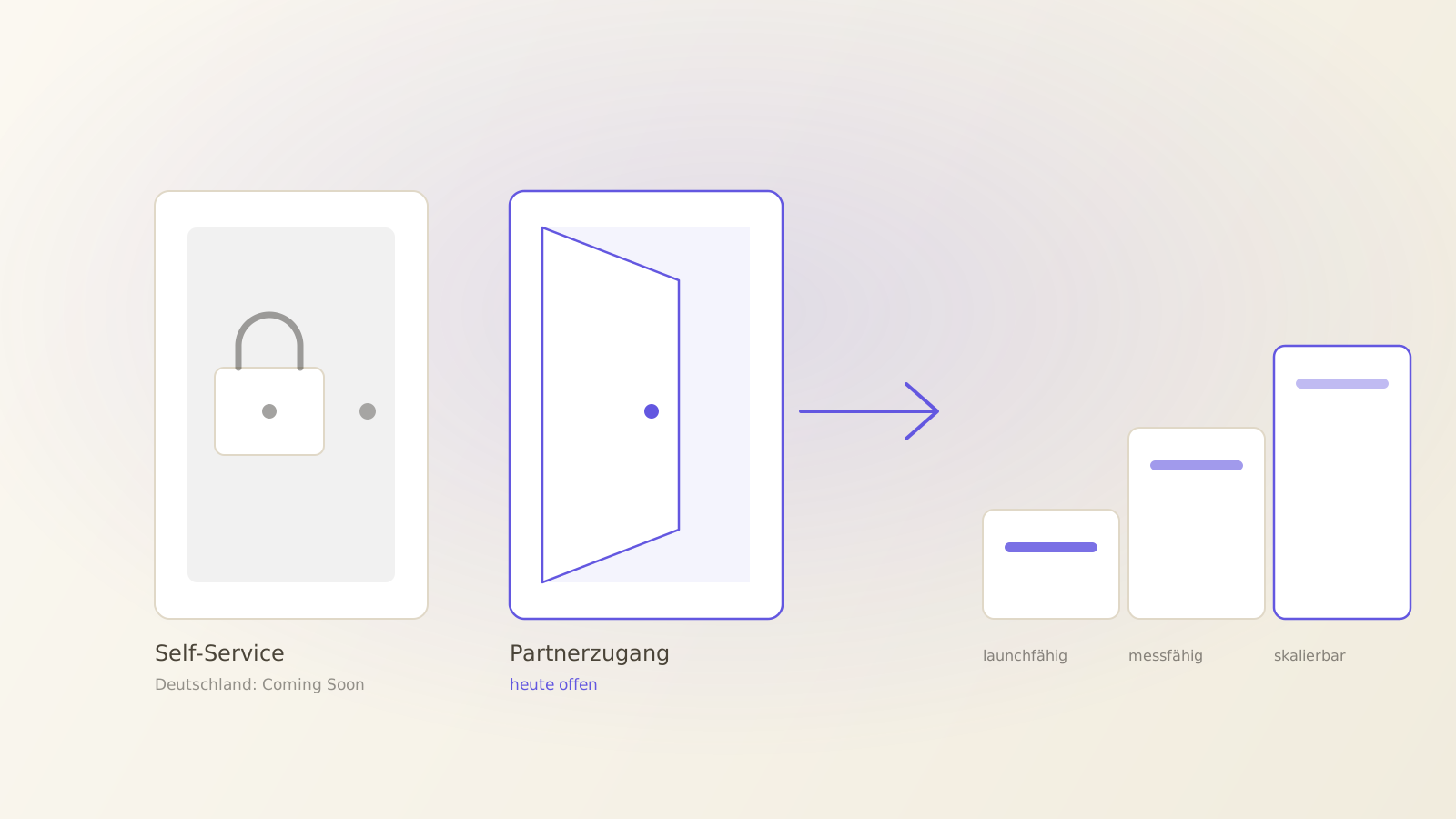
Important update, 1 September 2026, one day after publication. Self-service is open in Germany. OpenAI's availability overview has listed Germany as "Available" since this morning, together with the other European markets and several new ones beyond them. In parallel OpenAI is emailing advertisers that the ChatGPT Ads Manager is now available to advertisers based in Europe. We checked it against a real account: a campaign for Germany can be created.
That settles the question this text is titled after. You no longer have to go around self-service. What is not settled is everything from section 2 onwards: the technical preparation, the measurement and the feed are unchanged, and self-service asks for them exactly as partner onboarding did. Skip sections 2 to 4 and you have an open channel with nothing to send through it.
We are leaving the text standing rather than quietly rewriting it. The partner route still exists, and how fast a situation like this turns is itself information: one day passed between the writing and this line.
Two sentences are circulating and both are wrong. One says ChatGPT Ads are available in Germany. The other says nothing is possible in Germany yet. The truth sits between them, and it is written in OpenAI's own help centre.
1. What actually applies today
OpenAI's availability overview lists Germany under "Coming Soon". Self-service is currently available in Australia, Brazil, Canada, Japan, Korea, Mexico, New Zealand, the United Kingdom and the United States. All 31 countries of the European expansion sit on "Coming Soon".
OpenAI separates two things explicitly: "Account creation and self-service availability are separate: access depends on your country." So you can create an account; you cannot yet use self-service. Anyone who registers gets notified once their country is enabled.
Alongside that sits the route that is open today: "Advertisers in the new European markets can currently get started through the OpenAI Ads Solutions team, agency partners, or technology partners." For larger advertisers OpenAI also points to a contact form for sales support.
In practice: if you want to run ads today, you go through the partner route. If you would rather wait, create the account anyway and prepare the technical side, because partner onboarding asks the same questions.
2. Stage one, ready to launch: the crawler has to get through
This is the one hard requirement, and it depends on your infrastructure rather than your budget. OpenAI puts it without wiggle room: "You must allow OAI-AdsBot."
The crawler checks your landing page against the ad policy, and the content of the page feeds into deciding when your ad fits. OpenAI additionally recommends OAI-SearchBot; it is not mandatory.
In practice the layers behind robots.txt matter more. OpenAI lists them itself:
robots.txt. If the path is disallowed, crawling stops immediately. An explicit Allow for OAI-AdsBot is the safe route.
WAF, CDN and bot mitigation. Cloudflare, Akamai and others often block automated traffic with a 403 even when it is legitimate. For Cloudflare, OpenAI states that OAI-AdsBot is verified and allowlisted.
Human verification. CAPTCHAs, JavaScript challenges, behavioural analysis and session checks still bite even when the first two layers are open.
Rate limits. Large batch uploads trigger throttling. OpenAI advises uploading in smaller batches and watching for 429s.
Two sentences from the same source save a lot of time. First: do not count on a manual bypass from support, the page has to be genuinely reachable. Second: after fixing access you may need to re-upload or resubmit affected ads, because the status does not always update on its own.
One more limit that retail tends to miss: the landing page should be a directly reachable web page. App-store links, deep links, documents or destinations requiring an app, a login or region-specific access often do not provide enough crawlable content.
If you take one thing from this text: check whether your landing pages return a successful status code to OAI-AdsBot. Everything else comes after that.
3. Stage two, ready to measure: no attribution, no steering
Measurement is not a condition of launching. A simple campaign runs without it. But without measurement you can only serve, not steer.
Measurement runs through a data source in Ads Manager, fed either by the OpenAI Pixel, by the Conversions API, or by both. Four conditions have to come together for a conversion to be counted at all: the event comes from a connected data source, it matches a conversion event configured for the campaign, it falls within the attribution window, and OpenAI can connect it to an eligible click.
The key to that is oppref. It is OpenAI's click reference, appended to the landing page URL; the Pixel stores it in a first-party cookie, and the Conversions API accepts it. Three concrete tasks follow:
oppref has to survive redirects and navigation on the landing page. Strip parameters at the first redirect and the attribution is gone.
If you send server side, include oppref where it is available.
If you run Pixel and API in parallel, send the same event ID, otherwise OpenAI counts twice.
Two things temper the expectation, and it is better to know them up front. Automatic advanced matching hashes recognised customer information in the browser with SHA-256 and sends no raw data, but it assumes you hold the necessary consents. And the numbers from OpenAI, from your analytics provider and from other platforms will differ. OpenAI names the reasons itself: different attribution methods and windows, time zones, consent and storage conditions, different deduplication, and modelled conversions. A difference is not automatically an error.
4. Stage three, ready to scale: the product feed
For retail and catalogue businesses the feed is the lever that turns a campaign into a programme. On its effect OpenAI says: "Ads created from product feeds have been among the strongest-performing ads in our program to date." That is a vendor statement, not an independent measurement, and we pass it on as exactly that.
The flow sits in Ads Manager: create a feed under Tools, import products, wait for processing, create a campaign of type Product feed, cut an ad group with product filters, build an ad template, review, submit.
Three details decide how it runs day to day:
The import route. CSV or TXT to get started, a hosted URL for a stable HTTPS endpoint, SFTP for automated server-to-server handover. OpenAI adds a sentence that settles the choice: items expire after two weeks. A manual import is therefore a test, not a permanent setup.
The grouping. If the filters are not enough, you can set your own values in the ads_metadata field, for example bidding_tier or product_line, and cut ad groups by them. This is where clean catalogue logic pays off.
The ad template. It currently only supports selecting the image field. What lands in titles and descriptions comes from the feed. Sloppy feed data cannot be repaired in the template.
Two points that cause confusion in daily use and that you should know beforehand. The Products tab is a reporting view, not an inventory list: a product appears there only once there is delivery data, and after launch that can take up to seven hours. How many products are actually ready to serve is shown by the product count when you create the ad group. And during the beta, feed products are usable for ads only; they do not appear in organic ChatGPT conversations. OpenAI holds out the prospect of opening that later but does not promise it.
5. The honest limits
So that nobody starts with the wrong expectations:
Self-service has been open in Germany since 1 September 2026. The partner route remains alongside it, above all for larger advertisers.
Successful technical preparation is not an approval. OpenAI's review decides on the ad, not your setup.
Structured data on the landing page helps, but it is not required for ordinary landing pages, and it does not replace the product feed you upload in Ads Manager.
Figures on effectiveness so far come from OpenAI itself. There is no independent measurement we could cite.
6. What Klariton contributes
We pulled the three stages into one report, because they belong in this order and because each stage concerns a different team.
Ready to launch. The free ChatGPT Ads Readiness check tests from the outside whether OAI-AdsBot is allowed to read your landing page. No sign-up, straight for your domain. This is the stage most sites fail at, and it is the only one OpenAI declares mandatory.
Ready to measure. The check detects whether an OpenAI conversion measurement is present. The rest, meaning events, oppref surviving redirects and the consent question, is hand work on your side. We tell you what is missing; we do not build it into your checkout.
Ready to scale. The question and answer pairs and buying situations that good product copy and Context Hints are made of are what Owned Intelligence draws from your approved material, and Buying Answers turns into visible buying decision questions. Whether you appear in AI answers at all is what Prompt Monitoring measures.
What we do not do: enable campaigns, open accounts, or negotiate with OpenAI on your behalf. We are not an ads reseller. What we deliver is the work that comes before, and it holds whether you start through a partner or wait for self-service.
Sources
OpenAI Help: Ads Manager Availability (retrieved 28 Aug 2026, again 1 Sep 2026: Germany "Available")
OpenAI Help: Advertiser Guidance for Allowing OpenAI Web Crawlers (retrieved 28 Aug 2026)
OpenAI Help: Conversion Measurement (retrieved 28 Aug 2026)
OpenAI Help: Create Campaigns from Product Feeds (retrieved 28 Aug 2026)
Ask your question about Klariton.
Grounded in Klariton’s own knowledge, cited rather than invented.
Klariton is an Answer Engine Optimization platform. It adds to your existing shop or website without replacing anything or migrating data. Your own knowledge becomes verified, source-based answers (BIQs) that AI assistants and your visitors use directly.
Product copy, FAQs, spec sheets, your CMS or shop catalog. Klariton processes your material read-only and turns it into cited answers. Your data is never used for model training.
All AI calls run EU-hosted. Personal data is pseudonymized before every call. Klariton reads your sources read-only and stores no plain-text customer data.
Every answer is source-backed and passes a review gate. Nothing is published unchecked. Safe Guard continuously watches published answers against your material and flags outdated or weak claims.
No. Klariton integrates with your existing site, with no platform switch or migration. One embed is enough, and your CMS stays the source of truth.
Plans scale with touchpoints and answer volume. The AI visibility check is free and needs no sign-up. For everything else, just talk to us.
How visible is your brand to AI?
The free AI visibility check shows you in under a minute how AI assistants see your shop today.