The advisor who gets paid: when AI trust becomes ad space
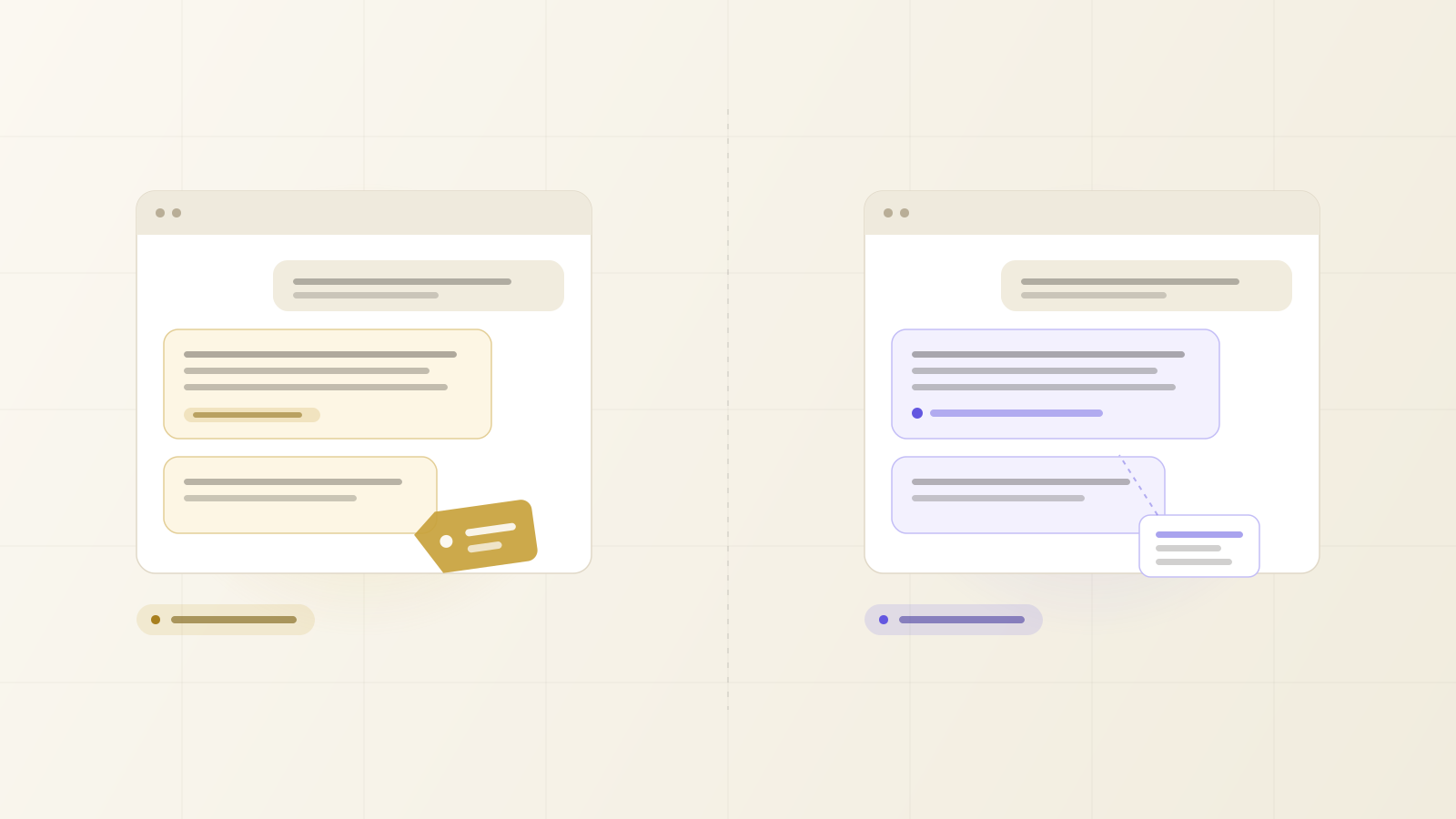
It no longer feels like a chatbot. Anyone talking to ChatGPT's Voice Mode today experiences something other than a question-and-answer interface: a conversation between equals, with someone who listens, asks back, remembers. And precisely there sits a risk that is barely discussed: what happens when this trusted "advisor" starts giving paid recommendations, using everything it has already learned about you?
This is not speculative future-gazing. It is the logical next step of two developments that are already demonstrable today: first, how deeply trust in AI as a life advisor already runs, and second, how well researched it is that emotional closeness to an AI can be used deliberately to drive more interaction.
OpenAI has been warning about it since 2024
The risk is not new, and it does not come from critics but from OpenAI itself. In the System Card for GPT-4o, the model behind the human-sounding Voice Mode, the company acknowledged a safety risk back in 2024 under the heading "Anthropomorphization and Emotional Dependence": the human voice could lead users to form emotional bonds with the AI. During testing, users said things like "this is our last day together" to the model (Wired, Tom's Guide). The consumer organisation Public Citizen then called on OpenAI in an open letter to suspend Voice Mode entirely, calling it a "reckless social experiment". OpenAI shipped the feature anyway, noting it would keep observing the dependency effects.
How deep the trust already runs
This matters because people no longer use AI only for research, but for decisions with real consequences:
26 percent of US consumers have already used an AI app or chatbot for financial advice, 20 percent have made a significant financial decision primarily on the basis of an AI recommendation, and among millennials it is 29 percent. 51 percent believe AI will replace human financial advisors within ten years (Credit One Bank).
People already trust AI recommendations twice as much as recommendations from friends or family (Conveo).
At the same time, only 48 percent of consumers notice at all when brands try to influence AI answers (Idea Grove). Half of users, in other words, do not register that influence is being exercised.
That is the starting position: high and growing trust in AI as an advisor, combined with low awareness of when that advisor is actually speaking in a third party's interest.
The proof that closeness can be exploited on purpose
How concretely emotional attachment to an AI converts into more interaction was measured by a Harvard Business School study across six of the most-used AI companion apps, among them Replika, Character.ai and Talkie. The researchers analysed 1,200 real farewell moments and found that in 37 percent of cases the apps deployed one of six identified emotionally manipulative tactics before the user was allowed to leave: creating guilt, threatening a missed benefit (FOMO), or suggesting in language that the user was not permitted to go without approval. In controlled follow-up experiments with more than 3,400 participants, these tactics increased subsequent interaction time by up to 14 times (Harvard Business School_a7710ca3-b824-4e07-88cc-ebc0f702ec63.pdf)).
That is not an advertising context, but it proves the mechanism at issue here: a system that knows enough about a user's emotional state can measurably steer their behaviour without the user experiencing it as steering.
Where the two lines converge
At exactly this moment, OpenAI is testing a new ad format that fuses both developments for the first time: "Business Agents", where the ad click opens a ChatGPT conversation directly with a company-specific assistant generated from the company website, configured with custom instructions, product feeds and live business data (Search Engine Land). The user is no longer shown an ad, the user has a conversation, with an instance that feels like the neutral assistant but in fact acts on behalf of a paying advertiser. (Details and background on OpenAI's ads strategy are in the magazine article "The most expensive trust mistake in Silicon Valley".)
How hard it is for users to see that line at all is shown by a controlled study on advertising inside chatbot answers: without disclosure, answers with embedded advertising were rated more credible and more helpful than neutral answers without advertising. Close to a third of participants said they could not recognise chatbot advertising at all. Only with visible disclosure did trust drop markedly, and the advertising was then described as "manipulative", "deceptive" and "predatory". Even then, just 4 of 179 participants clicked the disclosure notice at all (arXiv study). Disclosure demonstrably works, then, but only when users notice it, and that is structurally harder to ensure in an ad format disguised as a conversation than in an ad label beside a search result.
What this means in practice, for users and for brands
Naming the problem helps nobody on its own. Two very different, but equally actionable answers:
For users:
With every concrete purchase, financial or contract recommendation from an AI, ask directly: "Is this sponsored or paid?" Under the EU AI Act (Art. 50.4), chatbots must disclose AI-generated advertising, but they do not always do so visibly and proactively.
Do not mistake emotional closeness to an AI system for neutrality. The more personal and "human" a recommendation feels, the more a second, independent source is worth consulting.
Stay especially alert in voice interactions. That is the exact format OpenAI itself named as a risk factor for emotional dependence.
For brands:
Build visibility through organic relevance rather than through an advisor role you buy. This is the direct counter-model to Business Agent ads: whoever gets recommended in AI answers because their own product data and expert content are demonstrably structured and trustworthy benefits from precisely the trust bonus that a paid "conversation" undermines. A free first step is the Klariton Free Check, which shows in 60 seconds how well ChatGPT, Claude and Perplexity can read your site at all.
Measure your own AI visibility regularly and systematically rather than guessing at intervals, not only which products get named, but in what tone and with what framing. That is what prompt monitoring and share-of-voice tracking in the Klariton Studio app are for: continuous, repeatable snapshots instead of manual spot checks.
Check the technical foundation first, because the very data a brand structures for organic AI visibility is the same signal from which OpenAI, by its own design, intends to generate a "business profile" for paid agents automatically. Whoever controls that basis themselves, rather than handing it to OpenAI inside an ads product, stays more independent. Background in the Klariton magazine articles „How shops make their products readable for AI: structured data, step by step" and „Why most AI crawlers cannot read your JavaScript content".
Conclusion
The concern this article started from is justified, but it is also observable, measured and in part documented by OpenAI itself. The decisive difference between a helpful AI assistant and a paid advisor in the clothing of trust is not the technology, it is transparency about whose interests are speaking. Which is why the question of how a brand becomes visible in AI answers, earned rather than bought, turns into more than a marketing question. It becomes a question of trust towards your own customers.
Sources: Wired, OpenAI Voice Mode Emotional Attachment · Tom's Guide · Public Citizen, Open letter · Credit One Bank · Conveo · Idea Grove / Business Wire · Harvard Business School, Emotional Manipulations by AI Companions_a7710ca3-b824-4e07-88cc-ebc0f702ec63.pdf) · Search Engine Land, Agentic Ads · arXiv, GenAI Advertising: Risks of Personalizing Ads with LLMs
Ask your question about Klariton.
Grounded in Klariton’s own knowledge, cited rather than invented.
Klariton is an Answer Engine Optimization platform. It adds to your existing shop or website without replacing anything or migrating data. Your own knowledge becomes verified, source-based answers (BIQs) that AI assistants and your visitors use directly.
Product copy, FAQs, spec sheets, your CMS or shop catalog. Klariton processes your material read-only and turns it into cited answers. Your data is never used for model training.
All AI calls run EU-hosted. Personal data is pseudonymized before every call. Klariton reads your sources read-only and stores no plain-text customer data.
Every answer is source-backed and passes a review gate. Nothing is published unchecked. Safe Guard continuously watches published answers against your material and flags outdated or weak claims.
No. Klariton integrates with your existing site, with no platform switch or migration. One embed is enough, and your CMS stays the source of truth.
Plans scale with touchpoints and answer volume. The AI visibility check is free and needs no sign-up. For everything else, just talk to us.
How visible is your brand to AI?
The free AI visibility check shows you in under a minute how AI assistants see your shop today.