Perfect Product Data for AI: How Deep Structured Data Puts Your Brand in the Answer
The basic schemas are becoming commodity. The edge is product data that answers real questions: dimensions, water-tank position, maintenance intervals. With full JSON-LD examples and a reference table. As of July 2026.
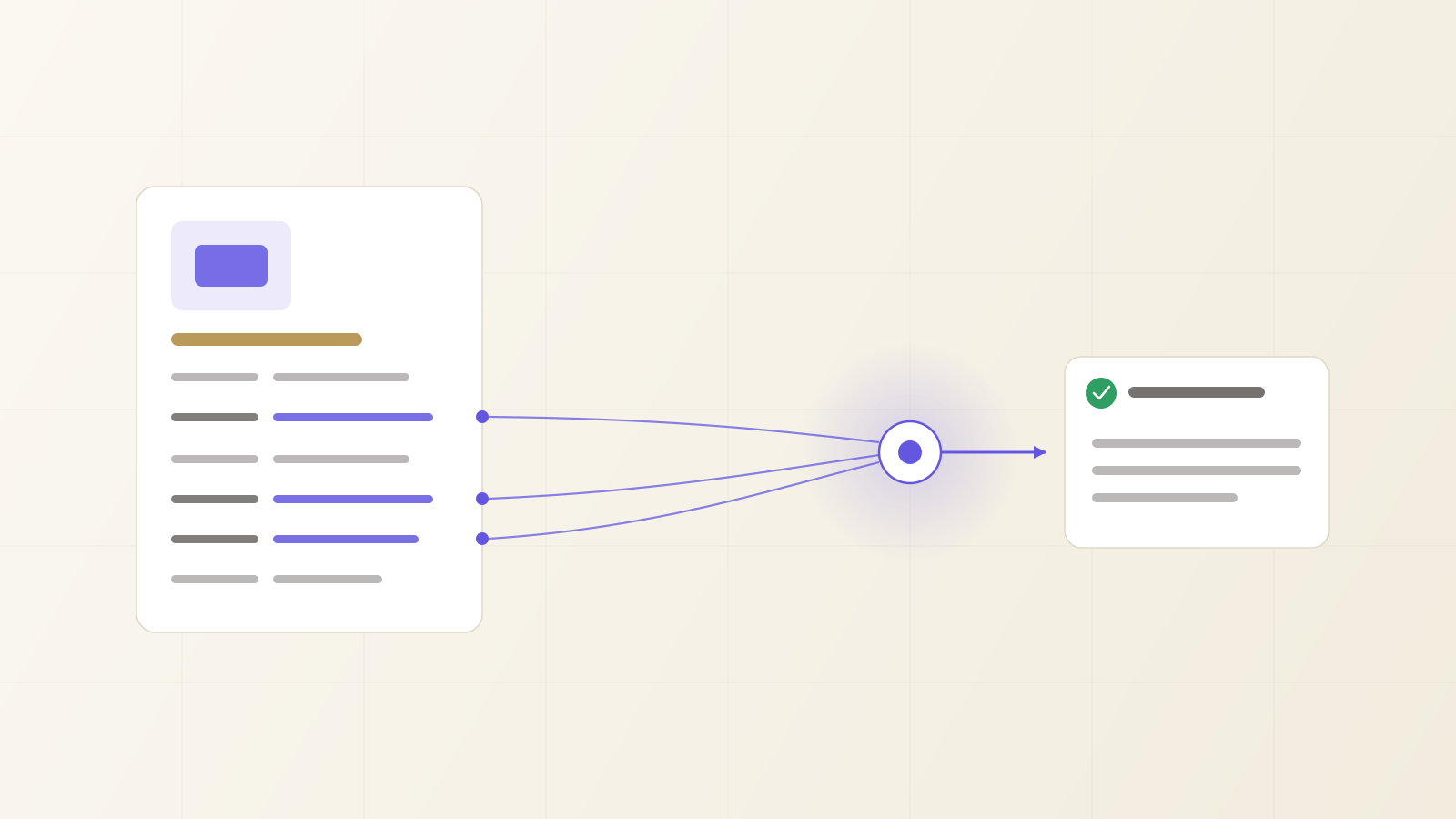
AI assistants like ChatGPT, Perplexity, Gemini, Claude and Copilot do not read your page the way a human sees it. They read the text and a machine-readable layer beneath it: structured data in schema.org format, usually as JSON-LD.
The basic schemas for that (FAQPage, a Product with name and price, Organization) are mandatory but not an advantage. Every developer will soon do them, they are the floor. The real leverage sits above: data that answers the actual question behind a prompt.
How people really ask
Nobody searches for "espresso machine 25 cm wide". They search a situation:
"I need a portafilter for a small kitchen that also makes cappuccino. The water tank has to go in from the side, there is a cabinet above the machine."
The assistant breaks that into follow-ups: dual boiler or single? How wide and tall? Can the tank be filled from the side? Milk frothing? Budget? Every one of those follow-ups is a field in your product data, or a gap that drops you out of the answer.
And queries are getting more specific, not necessarily longer. Whether as a full sentence or keyword-like, the decisive constraints, the small kitchen, the side-loading tank, the budget, are usually in the first prompt already. Each one is a data field you either answer or you don’t.
The minimum versus the depth
This is the Product minimum most shops ship. Formally correct, but it answers none of the questions above:
{
  "@context": "https://schema.org",
  "@type": "Product",
  "name": "Roma Dual Espressomaschine",
  "brand": { "@type": "Brand", "name": "Naturbohne" },
  "offers": {
    "@type": "Offer",
    "priceCurrency": "EUR",
    "price": "899.00",
    "availability": "https://schema.org/InStock"
  }
}
And this is the same product when the data actually answers the questions. The carrier is additionalProperty for free-form specs plus width/height/depth as QuantitativeValue:
{
  "@context": "https://schema.org",
  "@type": "Product",
  "name": "Naturbohne Roma Dual, Siebträger-Espressomaschine",
  "brand": { "@type": "Brand", "name": "Naturbohne" },
  "category": "Siebträger-Espressomaschine",
  "description": "Dual-Boiler-Siebträger für Espresso und Cappuccino, kompakt für kleine Küchen.",
  "image": "https://example.com/roma-dual.jpg",
  "width":  { "@type": "QuantitativeValue", "value": 25, "unitCode": "CMT" },
  "height": { "@type": "QuantitativeValue", "value": 38, "unitCode": "CMT" },
  "depth":  { "@type": "QuantitativeValue", "value": 42, "unitCode": "CMT" },
  "weight": { "@type": "QuantitativeValue", "value": 14, "unitCode": "KGM" },
  "additionalProperty": [
    { "@type": "PropertyValue", "name": "Boiler-System", "value": "Dual-Boiler, getrennt für Brühen und Dampf" },
    { "@type": "PropertyValue", "name": "Wassertank", "value": "2,5 l, seitlich entnehmbar, Befüllung von oben nicht möglich" },
    { "@type": "PropertyValue", "name": "Milchgetränke", "value": "Ja, professionelle Dampflanze für Cappuccino und Latte" },
    { "@type": "PropertyValue", "name": "Aufheizzeit", "value": "ca. 6 Minuten" },
    { "@type": "PropertyValue", "name": "Entkalkungsintervall", "value": "alle 2 Monate bei mittlerer Wasserhärte" },
    { "@type": "PropertyValue", "name": "Ideal für", "value": "kleine Küchen und Einsteiger mit Espresso-Anspruch" }
  ],
  "offers": {
    "@type": "Offer",
    "priceCurrency": "EUR",
    "price": "899.00",
    "availability": "https://schema.org/InStock",
    "url": "https://example.com/roma-dual"
  }
}
Every line in the additionalProperty block answers a concrete prompt: the water-tank line answers "can I fill it from the side", the milk line "does it make cappuccino", the descaling interval the maintenance question. That is the difference between findable and recommended.
Why depth wins the upper funnel
The point is not just completeness, it is who owns the answer. When a user asks about a niche they do not yet tie to a brand, the AI builds the shortlist from whatever structured facts it can find. Supply the deep data and your brand shows up in the upper funnel, in front of people who did not know you before.
And beware the wrong metric: being cited as a source is not the same as being recommended. Monitoring tools count how often your brand shows up as a source on broad category prompts. But the user decides nothing there, they are still on the journey. The recommendation only lands when the AI narrows to concrete constraints, and there whoever answers the constraints in their data wins, not whoever collected the most source mentions.
Do not supply it and the retailer will. The big electronics retailer maintains exactly these specs, plus price, and then stands in front of you in the answer. It owns the comparison, and usually whoever got there first wins.
The retailer tells price. The brand tells heritage and story. But both have to be machine-readable, or the AI only hears the retailer.
So your defense is twofold: the deep, honest specs and the brand story, both as structured data, so the AI does not just cite the retailer’s price in the comparison.
Another example: air conditioner
This holds for any category with a consideration phase. An AC maker answers the questions people actually ask through additionalProperty: room size, night-time noise, exhaust hose required, maintenance and filter intervals.
{
  "@context": "https://schema.org",
  "@type": "Product",
  "name": "Naturbohne AirCool 3000, mobiles Klimagerät",
  "brand": { "@type": "Brand", "name": "Naturbohne" },
  "additionalProperty": [
    { "@type": "PropertyValue", "name": "Kühlleistung", "value": "3,4 kW (12.000 BTU)" },
    { "@type": "PropertyValue", "name": "Geeignet für Raumgröße", "value": "bis 35 m²" },
    { "@type": "PropertyValue", "name": "Lautstärke", "value": "52 dB im Nachtmodus" },
    { "@type": "PropertyValue", "name": "Abluftschlauch", "value": "erforderlich, 1,5 m im Lieferumfang" },
    { "@type": "PropertyValue", "name": "Filterwechsel", "value": "alle 3 Monate, waschbarer Vorfilter" },
    { "@type": "PropertyValue", "name": "Wartung", "value": "Kondenswasser bei Dauerbetrieb wöchentlich prüfen" }
  ]
}
"Which portable AC is quiet enough for a bedroom and fits 30 square meters?" is a real prompt. Without these fields you are invisible for it.
Coffee and food: when the AI tastes along
This is where it gets powerful, because the AI reasons for you. You do not have to claim "tastes chocolatey". You supply the facts, and the model’s world knowledge derives the rest:
{
  "@context": "https://schema.org",
  "@type": "Product",
  "name": "Naturbohne Finca La Esperanza, Bio-Kaffee ganze Bohne",
  "brand": { "@type": "Brand", "name": "Naturbohne" },
  "category": "Spezialitätenkaffee",
  "additionalProperty": [
    { "@type": "PropertyValue", "name": "Varietät", "value": "Bourbon und Caturra" },
    { "@type": "PropertyValue", "name": "Herkunft", "value": "Finca La Esperanza, Huila, Kolumbien" },
    { "@type": "PropertyValue", "name": "Anbauhöhe", "value": "1.750 m ü. NN" },
    { "@type": "PropertyValue", "name": "Aufbereitung", "value": "gewaschen (washed)" },
    { "@type": "PropertyValue", "name": "Röstgrad", "value": "mittel, für Filter und Espresso" },
    { "@type": "PropertyValue", "name": "Geschmacksnoten", "value": "Schokolade, Nougat, rote Beere" },
    { "@type": "PropertyValue", "name": "Zertifizierung", "value": "EU-Bio, DE-ÖKO-001" }
  ],
  "offers": {
    "@type": "Offer",
    "priceCurrency": "EUR",
    "price": "16.90",
    "availability": "https://schema.org/InStock"
  }
}
From world knowledge the model knows that a washed Bourbon from Huila at 1,750 m tends toward chocolate and balanced sweetness. When a user asks for an organic bean from a roaster that tastes chocolatey and of nougat, you get recommended, because varietal, origin, altitude, process and certification together add up to exactly that profile. Facts turn into a recommendation, even for a subjective question.
This holds for every food producer: ingredients, origin, processing and certifications let the AI infer taste, dietary fit and occasion, instead of only matching the exact product name.
The mandatory base
The deep product layer does not stand alone. Underneath sits the base that covers every page type. A FAQPage entry, for instance, mirrors exactly the follow-up above, and the answer must be the same one visible on the page:
{
  "@context": "https://schema.org",
  "@type": "FAQPage",
  "mainEntity": [{
    "@type": "Question",
    "name": "Kann ich den Wassertank der Roma Dual von oben befüllen?",
    "acceptedAnswer": {
      "@type": "Answer",
      "text": "Nein. Der Tank wird seitlich entnommen und befüllt. Das ist praktisch, wenn ein Hängeschrank über der Maschine steht."
    }
  }]
}
The most common types with purpose and core required fields. This is the floor, the competitive edge sits in the depth above it. Full definitions at schema.org.
Type | Purpose | Core required fields |
|---|---|---|
Product | Product facts, price, availability | name, offers.price, offers.availability |
PropertyValue | Free-form specs that answer prompts | name, value (in additionalProperty) |
Offer | Price and availability (inside Product) | price, priceCurrency, availability |
FAQPage | Questions as citable Q&A | mainEntity[].name, acceptedAnswer.text |
Organization | Brand identity, heritage, channels | name, url, logo, sameAs |
LocalBusiness | Location, opening hours, contact | name, address, telephone |
Article | Editorial content, author, date | headline, author, datePublished |
BreadcrumbList | Navigation path of a page | itemListElement[].position, name, item |
AggregateRating | Bundle reviews | ratingValue, reviewCount |
BuyAction / Offer | Agentic commerce, buyable by AI agents | price, priceCurrency, availability, url |
As of, and upkeep
As of July 2026. schema.org and each AI engine’s requirements change. Treat your markup as a living document, not a one-off task.
The most important test comes last: does the AI actually render and cite your content, and with which facts? That is exactly what the free Klariton check measures, live against ChatGPT, Perplexity, Gemini and Claude. For the formal layer, the Schema.org validator (syntax) and the Google Rich Results Test (rich-results eligibility) complement it.
Ask your question about Klariton.
Grounded in Klariton’s own knowledge, cited rather than invented.
Klariton is an Answer Engine Optimization platform. It adds to your existing shop or website without replacing anything or migrating data. Your own knowledge becomes verified, source-based answers (BIQs) that AI assistants and your visitors use directly.
Product copy, FAQs, spec sheets, your CMS or shop catalog. Klariton processes your material read-only and turns it into cited answers. Your data is never used for model training.
All AI calls run EU-hosted. Personal data is pseudonymized before every call. Klariton reads your sources read-only and stores no plain-text customer data.
Every answer is source-backed and passes a review gate. Nothing is published unchecked. Safe Guard continuously watches published answers against your material and flags outdated or weak claims.
No. Klariton integrates with your existing site, with no platform switch or migration. One embed is enough, and your CMS stays the source of truth.
Plans scale with touchpoints and answer volume. The AI visibility check is free and needs no sign-up. For everything else, just talk to us.
How visible is your brand to AI?
The free AI visibility check shows you in under a minute how AI assistants see your shop today.