From digital butler to thinking partner
How people really use AI agents, and why that hands brands a new infrastructure problem
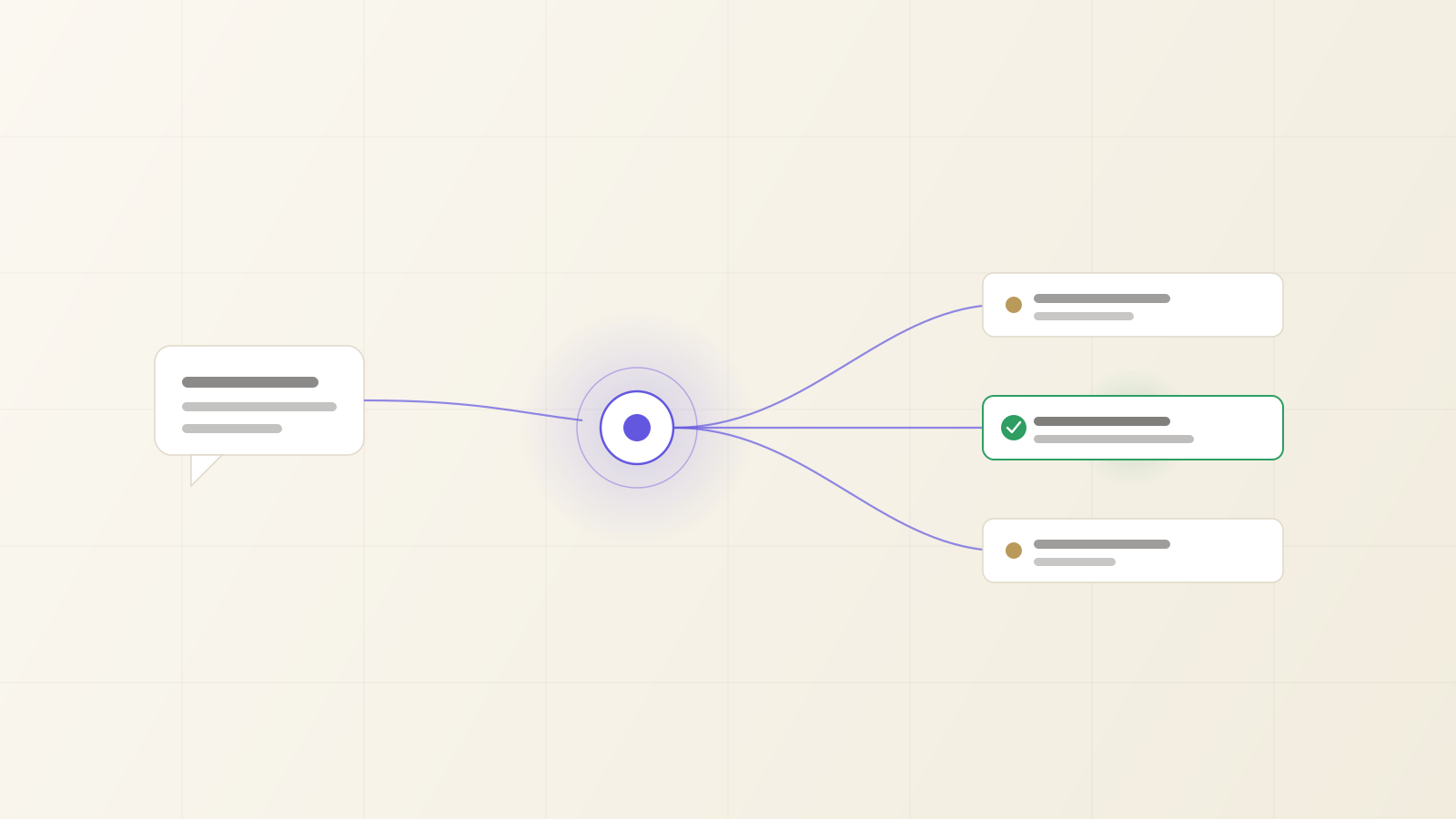
The popular idea of an AI agent is surprisingly small. It books a table, writes a cancellation, summarises a document. Useful, yes, but in the end just a slightly smarter assistant for tasks you wanted off your plate anyway.
Actual usage turns out to be much bigger. A joint analysis by Perplexity and researchers from Harvard shows that most agent usage is not about small errands but about cognitive work: thinking, planning, researching, structuring and deciding. That makes agents more than efficiency tools. They become a new layer between question and decision.
This is exactly what makes the topic interesting for brands. Once people outsource their first considerations, comparisons and preliminary decisions to agents, the decisive question shifts. It is no longer only whether a brand can be found. It is whether it appears in the answer layer of those agents at all, and in what form.
How people actually use AI agents
The study sorts usage into a few, but very telling, areas. The largest segment is productivity and workflows. Agents help summarise complex information, structure reports, prepare analyses or draft first versions. In these cases an agent does not replace the person. It takes over the first pass of thinking.
Second come learning and research. Students have difficult topics explained, compare arguments or get into new fields faster. Professionals use the same mechanism when they need to move quickly into an unfamiliar context before a meeting, a pitch or a decision.
Behind those sit media and content as well as shopping and selection. That last area looks smaller at first glance but is often the economically relevant one. Anyone asking an agent which grinder fits a given budget, which analytics tool suits a small team, or which vendor meets stricter data protection requirements has already outsourced part of the purchase decision. Selection then no longer begins in the shop, but in a conversation with a system that pre-sorts the options.
That is more than a change of interface. It is a change in the order in which decisions come about. Search used to start with a search engine and lead through several open tabs to a choice. Today it increasingly starts with a condensed answer in which the agent has already interpreted, filtered and prioritised.
The real shift: from tool to decision layer
The deeper break is therefore not that agents make work faster. It is what happens between question and answer. An agent does not merely collect content. It orders it, compares it, weighs it and turns it into a proposal. In doing so it takes over part of the groundwork that used to sit with the person: sifting, combining and classifying.
For users that feels convenient. For companies it changes the architecture of visibility. It is no longer enough for a piece of information to exist somewhere on a website. What matters is whether the agent can find it, understand it and judge it to be solid. Between “it is online” and “it gets recommended” there is suddenly an extra layer, read and condensed by machines.
That also shifts the power of the first mention. Anyone missing from that early pre-sorting is often already absent before a product page or a shop is opened at all. Agents are rarely the final authority. But they are increasingly the first one, and it is that first authority which shapes which brands and options are considered in the first place.
What this means for brands and commerce
For brands this is a fundamental change. For two decades digital visibility mainly meant being findable in search engines. In the agent era that is no longer enough. Visibility now means becoming part of a condensed answer: as a recommendation, as a named source, or at least as a correctly represented option.
That has direct consequences for commerce. When an agent compares products, explains categories, summarises pros and cons or weighs criteria such as price, availability, data protection and compatibility, purchase relevance is created before the click. The shop is then no longer where selection begins. It is often only where a preliminary decision gets confirmed.
There is a second problem on top: mistakes in this layer are particularly expensive for brands. When an agent names an invented property, picks up outdated data or does not consider a brand at all, the damage is rarely abstract. It shows up in worse recommendations, lost buying moments, follow-up questions and wrong expectations. Visibility in agents is therefore not only a reach question. It is a question of reliability, control and risk.
The new core question: what does the agent see of my brand?
Out of this comes a different guiding question than in the classic SEO era. It is no longer just “does my page rank?” It is: “what does an agent see when it asks about my brand, my range or my category on behalf of a customer?”
That question is more technical than it first sounds. Agents do not read a website the way people do. They often do not wait for client-side rendered content, they prefer clear structures, they draw on different source levels and they condense information by their own logic. What is designed to be visible and persuasive for people is therefore not automatically readable for machines.
This is exactly where a new infrastructure problem begins. Brands need not only good content, but content that answer systems can read, quote and rely on. And they need to know whether that content is actually being read, where it shows up in answers and what role it plays there.
Why Klariton fits this picture
This is where the development pays into Klariton directly. Not because the product decorates a trend, but because it addresses a very concrete problem: the gap between a website as people see it and a brand as agents read it.
A technical AI audit answers the basic question first: whether a site can be read usefully by AI crawlers at all. Many websites deliver key content only after JavaScript has run, or spread decisive information across poorly structured templates. For a person that may work. For an agent it can mean the actually relevant statement stays invisible.
On top of that sits Agentic Reach. Theoretical readability is only half the truth. Just as important is whether agents actually fetch the content, and which providers, categories or page types are involved. Only that difference between “could be read” and “is really being read” makes the problem measurable.
Another building block is the question of the role in the answer. With LLM Discovery and Trust Intelligence it becomes visible where a brand appears in answers: as a recommendation, as a source, as a footnote or not at all. That is strategically decisive, because only then is it clear whether a brand actually features in the new decision layer or merely believes it is digitally visible.
Then there is the content level. Products such as Buying Answers or a guided advisor make sure agents do not just find unstructured marketing text, but solid, concrete and quotable answers. Anyone who wants systems to name their brand correctly has to give them material that can be used precisely in the first place.
Finally there is the problem of drift. Ranges change, prices move, policies get adjusted. With Safe Guard and a Compliance Center a statement published once does not become a permanent truth, but a controlled state that can be checked against its sources continuously. Precisely because agents scale answers, every error multiplies too when that safeguard is missing.
Six practical consequences for decision makers
For teams in marketing, e-commerce, product and digital strategy, six concrete consequences follow.
1. Treat agents as a second interface
Next to the visible website a second interface emerges: the one for systems that read content, structure it and translate it into answers. That interface deserves the same attention as navigation, conversion or brand image.
2. Check readability technically
Server-side rendering, structured data, clean templates, clear product information and solid feeds are no longer mere developer hygiene. They decide whether agents see usable information at all.
3. Make visibility measurable
As long as nobody knows which systems read the brand and where it appears in answers, AI visibility stays a gut feeling. Measurement turns an assumption into something you can steer.
4. Build answers, not filler text
Generic SEO content loses value in a world of agents. What counts are precise, quotable and verifiable statements about real user questions. Systems prefer material that is clear, solid and concrete.
5. Monitor drift and errors continuously
What is correct today can be wrong tomorrow. Anyone taking answer systems seriously as a distribution channel has to keep checking statements, especially where product data, prices or policies change quickly.
6. Think in infrastructure, not in single campaigns
Visibility in agents is not a one-off project. It is a permanent layer that has to be read, measured, maintained and safeguarded. That is the difference between a short-lived trend topic and a real shift in digital architecture.
From experiment to everyday habit
The most important message of the study is not that people find AI agents interesting. It is that agents are quietly becoming the first stop for thinking, comparing and deciding. Many uses look mundane taken one by one. Added up, they amount to new behaviour: questions increasingly begin in an answer system rather than in a search engine or on a website.
That also shifts the decisive question for brands. Hoping your own page is found somewhere is no longer enough. What matters more is whether agents work with your brand, with your facts, your categories, your priorities and your language. Or whether they fall back on gaps, third-party data and vague assumptions instead.
This is why the topic is not a side note of digital communication. It touches product data, technical delivery, content structure, governance and brand management at the same time. And it is why an article about the actual use of AI agents pays into Klariton so directly: it explains how a seemingly abstract AI debate turns into a very concrete infrastructure question for brands.
Ask your question about Klariton.
Grounded in Klariton’s own knowledge, cited rather than invented.
Klariton is an Answer Engine Optimization platform. It adds to your existing shop or website without replacing anything or migrating data. Your own knowledge becomes verified, source-based answers (BIQs) that AI assistants and your visitors use directly.
Product copy, FAQs, spec sheets, your CMS or shop catalog. Klariton processes your material read-only and turns it into cited answers. Your data is never used for model training.
All AI calls run EU-hosted. Personal data is pseudonymized before every call. Klariton reads your sources read-only and stores no plain-text customer data.
Every answer is source-backed and passes a review gate. Nothing is published unchecked. Safe Guard continuously watches published answers against your material and flags outdated or weak claims.
No. Klariton integrates with your existing site, with no platform switch or migration. One embed is enough, and your CMS stays the source of truth.
Plans scale with touchpoints and answer volume. The AI visibility check is free and needs no sign-up. For everything else, just talk to us.
How visible is your brand to AI?
The free AI visibility check shows you in under a minute how AI assistants see your shop today.