Ads in Google AI Mode: why your product feed now writes the ad
At Marketing Live 2026, Google introduced ads for AI Mode in Search. They work differently from classic Shopping ads and differently from ChatGPT Ads: there is no keyword campaign to bid on. Gemini builds the ad from your product feed when it finds a product that fits a customer's question. And on the Search side the same principle applies to your website: Google picks the landing page and writes the ad copy from what is on it. What that means for ecommerce, and where the difference to ChatGPT Ads lies.
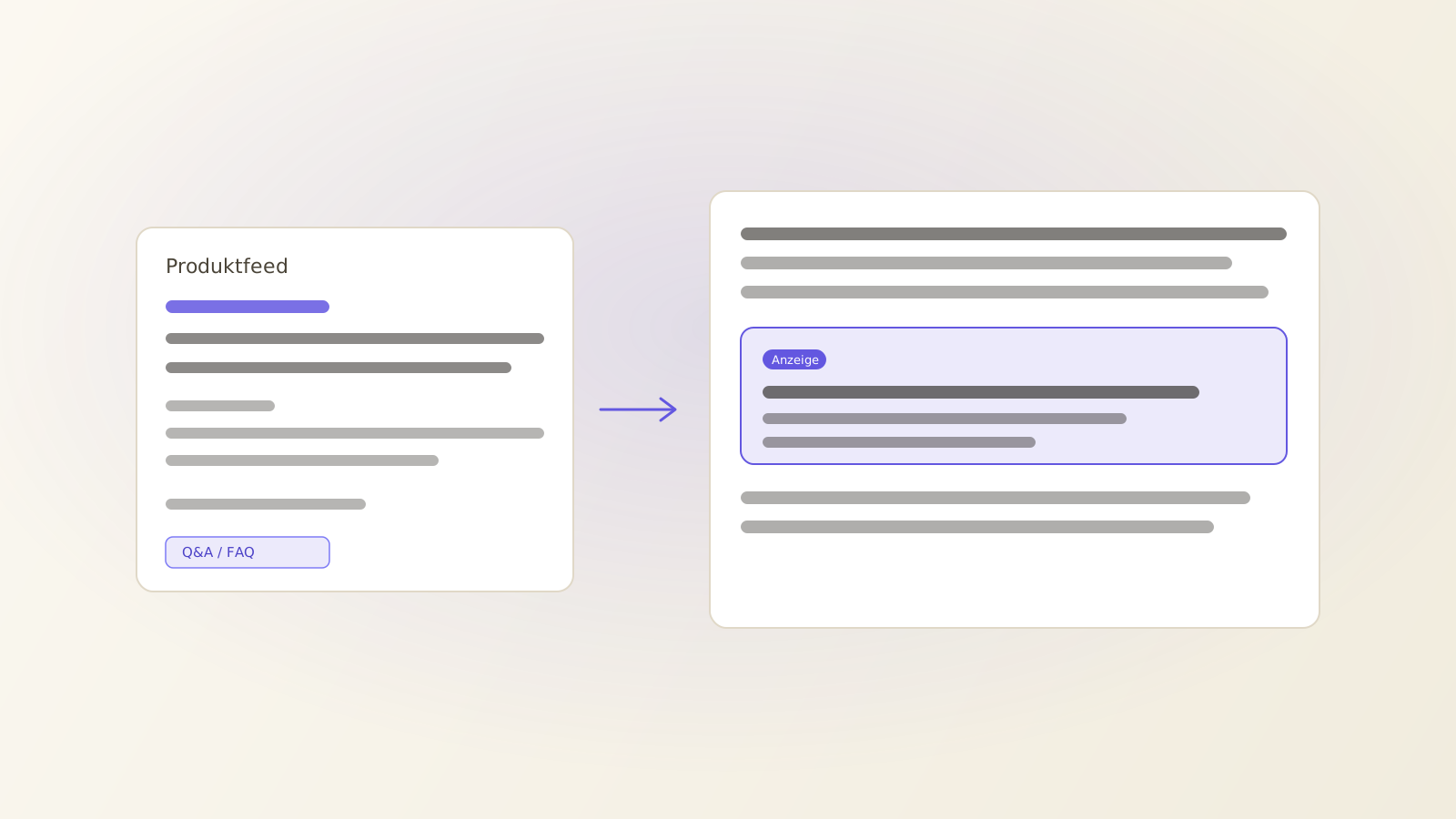
If you know Shopping ads, you think in campaigns, bids and audiences. For AI Mode that shifts. Google describes the new formats as built with Gemini inside Search and tailored to the concrete question a person asked. The ad does not go looking for a keyword; the conversation calls up the product, and what the ad is made of is your product data.
1. What Google announced
Ads for AI Search were introduced at Google Marketing Live 2026. From Google's own announcement:
Ads in AI Mode: sponsored answers that appear inline while someone is asking follow-up questions.
Direct Offers: product or offer prompts attached to an AI generated answer when the intent is commercial.
Delivery runs through existing campaign types, above all AI Max for Shopping and Performance Max, not through a dedicated AI Mode targeting.
Addendum, 8 September 2026. The last point no longer holds without qualification. In early September Google started a test in which ordinary Search campaigns using exact match and phrase match can serve text ads in AI Mode as well, so without AI Max and without Performance Max. This was confirmed by Ginny Marvin, Google's Ads Liaison, on LinkedIn. It is not in the Google Ads help pages, and we record that difference here because it matters for how much weight the claim carries. Google calls it a "small experiment" and limits it to queries with "explicit and direct user intent". Scope, countries, duration, whether it stays, and how these impressions can be measured at all are open. In practice that means the door into AI Mode is no longer the feed door alone. It is a test rather than something you can book, and it changes nothing about the work on the feed and on the pages.
Google gives as an order of magnitude that advertisers using AI Max or Performance Max see more conversions at a similar ROAS. We pass that on as a vendor figure, not as our own measurement.
2. The real break: the feed does the work of the ad copy
The sharpest sentence from the practitioner reporting sums it up: your feed does the work the ad copy used to do. Gemini decides from the product data whether your product fits a question and how it explains the connection. Data quality beats campaign settings.
In practice a feed entry is no longer just a catalogue field. It is the material the ad is written from. A title like "men's shirt blue" carries less than a title that names cut, fabric and occasion. If a piece of information is missing from the feed, it is missing from the ad.
3. Getting the feed ready
From the reporting, and consistent with Google's focus on the feed:
Make titles and descriptions specific: concrete detail instead of generalities.
Fill the conversational attributes, above all question and answer pairs in the style of an FAQ. Exactly the questions a customer asks in a dialogue.
For products that need explaining, give fabric, fit and durability in full.
Use supplemental feeds so you do not disturb the entries already running.
Start with your highest revenue items and bestsellers, not with the whole catalogue.
4. The other half: on the Search side your page writes the ad
The feed is only one of two rails. On the Search side a parallel shift applies the same mechanism to your website. It affects merchants who have not booked a single AI Mode format.
In AI Max for Search two settings work together. Google puts it like this: when Text customization and Final URL expansion are both on, Google may replace your given landing page with a more relevant one and "generate a dynamic headline, description, and additional assets to match your landing page content". Final URL expansion is on by default once you opt into AI Max, and it requires Text customization.
Translated: not just the feed, the text of your subpages becomes ad copy too. Any page Google considers a better fit can become the landing page. A thin category page with no substance is no longer a cosmetic flaw but a candidate for a weak ad.
None of this stays optional. Google has announced that from September 2026 existing Search campaigns with automatically created assets and with campaign level broad match will be upgraded to AI Max automatically. For Dynamic Search Ads, Google has since moved the date to February 2027, and new DSA campaigns are to become impossible to create through Google Ads, the Editor and the API. So the dates move; the direction does not. Run one of those settings and you get the change without ordering it.
You can still steer. Google introduced AI Brief for that. Messaging Guidelines set what your ads should and should not say. Matching Guidelines bound the searches you want. Text Disclaimers force required text to appear even when Final URL expansion swaps the landing page. At URL level you keep page feeds, rules on URL contains, and the exclusion of individual URLs.
As an order of magnitude Google cites 7 percent more conversions or conversion value at a similar CPA or ROAS when the full feature suite is used rather than search term matching alone. That is Google's own analysis for non retail advertisers, not an independent measurement, and we pass it on as exactly that.
5. The difference to ChatGPT Ads, precisely
The direct comparison is worth making, because the two platforms ask different things of you:
Google: two rails, both driven by data. In AI Mode structured product data is central, the feed is the ad. Without a maintained Merchant Center feed there is nothing for Gemini to build an ad from. On the Search side the content of your subpages joins in, because Final URL expansion derives both landing page and ad copy from it.
ChatGPT Ads: there the conversational context counts, and the landing page is read as a relevance signal. OpenAI explicitly does not require structured data on the landing page; it helps for product feed campaigns but is not a condition.
That is not a contradiction but a division of labour with two different levers. For Google you invest in the depth and accuracy of your product data. For OpenAI you invest in describing the buying situation and in landing pages that genuinely answer the question. If you want both channels, you need both.
6. Measurement is still unfinished
There is no dedicated AI Mode reporting yet. The available approximations are the conversational query data from AI Max and the movement in branded search. Google is testing AI Performance Insights in Merchant Center for share of voice metrics, initially in selected markets. If you know your organic starting point today, you can say later what the paid delivery moved. If you do not measure, you cannot go back and do it.
Two limits belong in the picture, because they set the expectation straight. According to Google's own help, ads in AI Overviews are currently available in English in thirteen markets, and Germany is not among them. There is no way to target that placement directly, and no reporting broken out by placement either: the clicks run in with Top Ads. The work on the feed and on the pages is still worth doing now, because it is the precondition rather than the booking.
7. What Klariton contributes
The raw material Google now reads out of the feed is the same one we surface from your material. The question and answer pairs a good feed needs are exactly the buying decision questions Buying Answers pulls out of your knowledge. The depth of product data that matters here is what Owned Intelligence builds. And whether you appear in AI answers at all is what Prompt Monitoring measures.
What we do not promise: that a well maintained feed guarantees a particular ad performance. Google's system decides that. What we deliver is the work that comes before it and holds regardless of platform: know the questions, make the product data accurate and complete, and do both so that a human and a machine can use it straight away.
Sources
Google Ads Help: See what we announced at Google Marketing Live 2026
Search Engine Journal: How To Advertise In Google AI Mode For Ecommerce
Google Ads Help: About Final URL expansion in Search (retrieved 27 Aug 2026)
Google: Dynamic Search Ads are upgrading to AI Max (retrieved 27 Aug 2026)
Google: Steer performance with new AI Max features (retrieved 27 Aug 2026)
Google Ads Help: About ads and AI Overviews (retrieved 27 Aug 2026)
Search Engine Land: Google tests traditional Search campaigns in AI Mode (retrieved 8 Sep 2026)
Ask your question about Klariton.
Grounded in Klariton’s own knowledge, cited rather than invented.
Klariton is an Answer Engine Optimization platform. It adds to your existing shop or website without replacing anything or migrating data. Your own knowledge becomes verified, source-based answers (BIQs) that AI assistants and your visitors use directly.
Product copy, FAQs, spec sheets, your CMS or shop catalog. Klariton processes your material read-only and turns it into cited answers. Your data is never used for model training.
All AI calls run EU-hosted. Personal data is pseudonymized before every call. Klariton reads your sources read-only and stores no plain-text customer data.
Every answer is source-backed and passes a review gate. Nothing is published unchecked. Safe Guard continuously watches published answers against your material and flags outdated or weak claims.
No. Klariton integrates with your existing site, with no platform switch or migration. One embed is enough, and your CMS stays the source of truth.
Plans scale with touchpoints and answer volume. The AI visibility check is free and needs no sign-up. For everything else, just talk to us.
How visible is your brand to AI?
The free AI visibility check shows you in under a minute how AI assistants see your shop today.